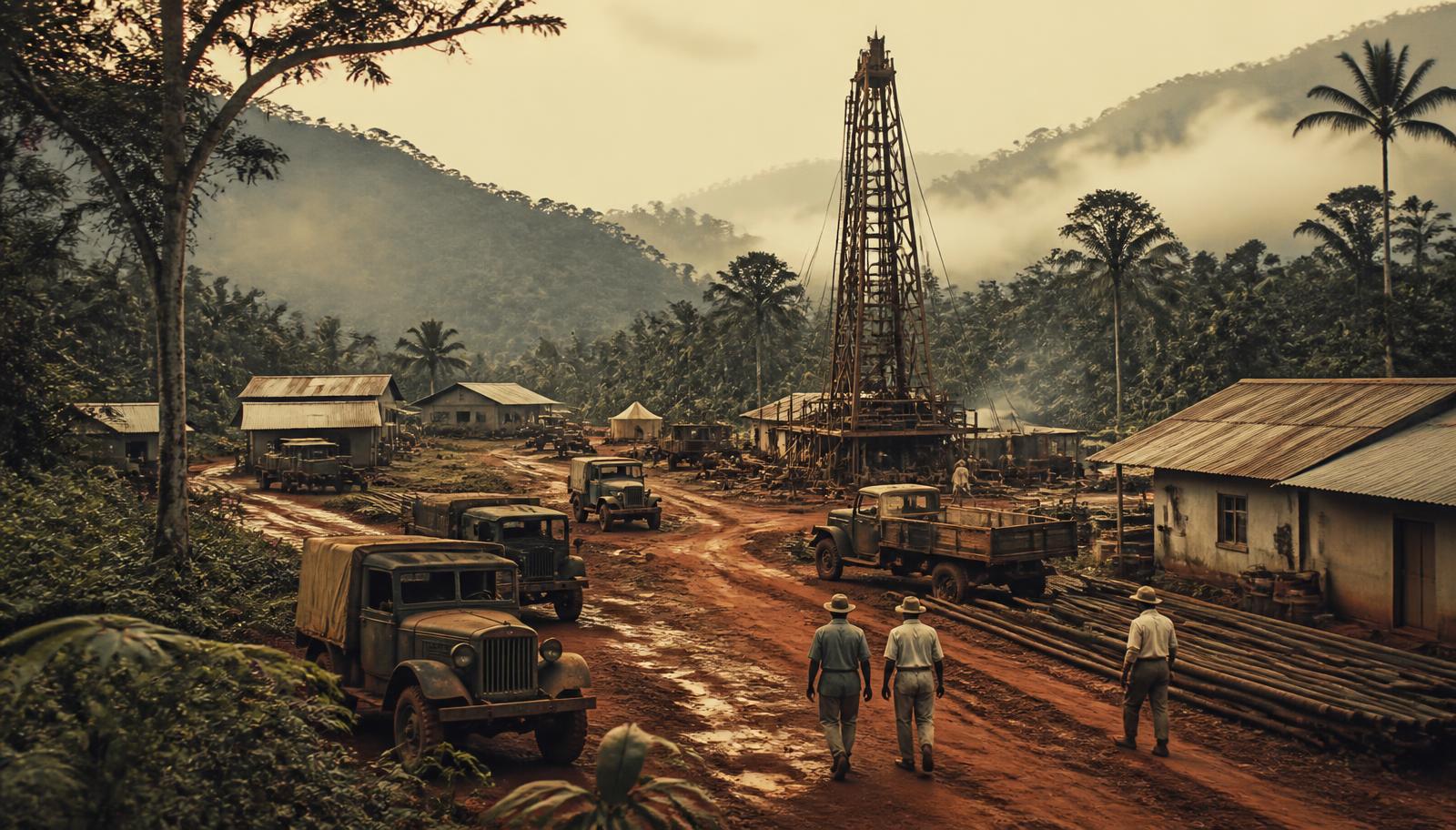
Shell D'Arcy receives an exploration licence over the whole of Nigeria
Oil Exploration Licence No. 1 grants the Shell D'Arcy consortium exclusive rights across roughly 357,000 square miles — effectively the entire colony. The communities living above the prospect are not parties to the grant, and the 1914 Mineral Oils Ordinance has already vested the minerals in the Crown.
Minerals Ordinance reaffirms Crown ownership
Post-war legislation restates that the entire property in and control of all minerals and mineral oils rests with the Crown, closing off any residual customary claim to what lies beneath Ijaw and Ogoni land.
First commercial discovery at Oloibiri
Shell-BP strikes oil in commercial quantity in Oloibiri, in what is now Bayelsa State. Production begins in 1958. Oloibiri's wells run dry within decades; the settlement itself never receives a piped water supply or reliable electricity from the field that opened Nigeria's oil age.
Ogoniland enters production; Bomu field opens
Shell's Bomu field begins producing in Ogoniland. Over the following decades roughly 100 wells and a dense network of flowlines and flare stacks are installed across a densely farmed 1,000 km² territory.
Willink Commission warns of minority fears
The pre-independence Willink Commission documents the anxieties of Niger Delta minorities and recommends a special development board — a recommendation that survives as an underfunded institution rather than a constitutional protection.
Isaac Adaka Boro's twelve-day revolution
Boro, Owonaru and Nottingham Dick declare the Niger Delta Republic, citing exclusion from the wealth of Ijaw land and water. The revolt is suppressed in twelve days, but it establishes the vocabulary of Delta self-determination.
Petroleum Act vests all petroleum in the Federation
Enacted under military decree during the civil war, the Petroleum Act places the entire property in and control of all petroleum, onshore and offshore, in the Federal Government, and centralises licensing.
The Bomu blowout
A well blowout at Bomu in Ogoniland spills for weeks across farmland. It becomes a founding grievance in the Ogoni case and one of the earliest documented mass-pollution events in the Delta.
Land Use Act vests land in state governors
All land in each state is vested in the governor, held in trust. Occupiers hold rights of occupancy that can be revoked for overriding public interest — a category that expressly includes petroleum operations. Compensation attaches to crops and structures, not to the land itself.
Offshore/onshore dichotomy and derivation collapse
Constitutional and fiscal changes reduce the derivation principle from the 50% of the pre-independence settlement to a fraction of it. Producing communities receive a shrinking share of a rapidly growing revenue base.
The Ogoni Bill of Rights
MOSOP, led by Ken Saro-Wiwa, publishes the Ogoni Bill of Rights: political autonomy, a fair share of oil revenue, and control of environmental protection in Ogoniland. It becomes the template for Delta minority claims.
300,000 march; Shell withdraws from Ogoniland
A mass mobilisation of roughly 300,000 Ogoni marks Ogoni Day. Shell ceases production in Ogoniland — but the pipelines crossing the territory remain in service and continue to fail.
Execution of Ken Saro-Wiwa and the Ogoni Nine
After a widely condemned military tribunal, Saro-Wiwa and eight colleagues are executed. Nigeria is suspended from the Commonwealth. The case becomes a permanent reference point in international corporate-accountability litigation.
Kaiama Declaration
Ijaw youth assembled at Kaiama assert Ijaw ownership of all land and natural resources in Ijaw territory and demand the withdrawal of military forces. The declaration reframes the Delta question in explicitly Ijaw terms.
Nigerian courts rule gas flaring unconstitutional
In Gbemre v Shell, the Federal High Court holds that continued gas flaring violates the constitutional rights to life and dignity. Flaring nonetheless continues for years under successive deadlines.
The Bodo spills
Two major spills from the Trans-Niger Pipeline devastate the Bodo creeks in Ogoniland. The scale of loss is later established in English proceedings rather than Nigerian ones.
UNEP Environmental Assessment of Ogoniland
UNEP documents contamination of soil and groundwater across Ogoniland, including benzene in drinking water at many times WHO guidance, and estimates an initial US$1bn fund and a 25–30 year restoration horizon.
Bodo settlement — £55 million
Shell settles the Bodo claims in the English High Court for £55m, most of it paid directly to individual claimants. The settlement establishes that Delta claims can be tried in the parent company's home jurisdiction.
HYPREP launched to implement the UNEP report
The Hydrocarbon Pollution Remediation Project is inaugurated to deliver the UNEP recommendations. Progress is repeatedly criticised for contracting delays, remediation quality and slow disbursement.
The Hague and the UK Supreme Court
The Dutch Court of Appeal holds Shell's Nigerian subsidiary liable for spills in Oruma, Goi and Ikot Ada Udo and orders a leak-detection system, while the UK Supreme Court in Okpabi v Shell rules that Nigerian claimants may sue the UK parent — a duty-of-care breakthrough.
Petroleum Industry Act
The PIA replaces the 1969 framework, creates NNPC Limited, NUPRC and NMDPRA, and mandates Host Communities Development Trusts funded at 3% of prior-year operating expenditure — with section 257(2) deducting the cost of repairing vandalised infrastructure from the community's own allocation.
€15 million Dutch settlement
Shell agrees a €15m settlement with the Oruma, Goi and Ikot Ada Udo communities following the 2021 ruling, alongside continuing remediation commitments.
The divestment wave
ExxonMobil, Eni and Equinor agree sales of onshore and shallow-water assets to Nigerian operators. Communities and civil society raise the central question of the decade: who carries the legacy pollution liability after the deed is signed?
Renaissance takes over SPDC's onshore joint venture
Shell completes the sale of the Shell Petroleum Development Company to the Renaissance consortium of Nigerian independents, closing 88 years of direct Shell onshore operation in the Delta. Outstanding remediation obligations, HCDT funding and pipeline integrity become the test of whether the handover changes anything on the water.