
1908 – 1956
Owerri Before Oloibiri: The Long Reconnaissance

Systematic exploration of southern Nigeria began decades before the famous strike. A German-backed venture drilled around Araromi as early as 1908; the concession that mattered most was granted in 1938, when Shell D'Arcy — a joint venture of Shell and what would become BP — received an exploration licence covering essentially the whole of the country. Owerri, on firm ground at the edge of the wetlands, became the logistics hub: workshops, bungalows, a survey office, a road network cut into red laterite.
The work was slow, expensive and, from the outside, opaque. Communities watched forest lines being cleared and reasonably assumed a new trading or plantation venture had arrived. Wartime interruption pushed the programme back; drilling resumed at the end of the 1940s, and the deep wells of that era — Ihuo among them — were dry or non-commercial. Oloibiri, in what is today Bayelsa State, was the breakthrough that finally justified almost two decades of sunk cost.
The point of recounting this is not that exploration happened. Every oil province has a reconnaissance phase. The point is what the legal framework of that phase assumed: that the people living above the resource were spectators to a decision already made elsewhere.
The founding assumption
The Colonial Mineral Oils Ordinance of 1914 vested all mineral oil in the British Crown and restricted licences to British subjects and British-controlled companies. Consent, consultation and benefit-sharing with the communities of the basin were simply not part of the instrument. That single design choice — ownership assigned upward, risk assigned downward — is the thread that runs through everything that follows.
1914 · 1969 · 1978
The Legal Inheritance: Three Statutes, One Logic

Independence changed the flag above the framework, not the framework. The Petroleum Act of 1969, passed during the civil war, vested the entire property in and control of all petroleum in the Federation. The Land Use Act of 1978 completed the structure by vesting all land in each state in the Governor, to be held in trust, with statutory and customary rights of occupancy granted at the Governor's discretion — and with oil operations treated as an overriding public interest that can justify revocation.
In practice, compensation under this regime attaches to visible, present loss — unexhausted improvements such as standing crops, economic trees and buildings — rather than to the long tail of ecological damage: soil hydrocarbon loading, groundwater contamination, lost fishery productivity and the decades of diminished livelihood that follow a spill. That gap between what is compensated and what is actually lost is the central grievance of the region, and it is a drafting problem as much as a moral one. Drafting problems can be fixed.
Communities do not object to the country earning from its resources. They object to being the only party to the bargain that carries the cost without holding a right.
2008 – present
The Hague and London: When Accountability Crossed Borders
Faced with a domestic framework that made recovery for long-term harm difficult, farmers and fishermen from Oruma, Goi, Ikot Ada Udo, Ogale and Bille did something remarkable: they sued in Europe. It took more than a decade, and the results reshaped the field.
In January 2021 the Court of Appeal in The Hague held Shell's Nigerian subsidiary liable for spills at Oruma and Goi, ordered compensation, and ordered the installation of leak-detection equipment on the Oruma pipeline — while also accepting, in principle, that the parent company owed duties in respect of its subsidiary's operations. Weeks later, the UK Supreme Court in Okpabi v Royal Dutch Shell ruled that the Ogale and Bille claims could proceed in England, rejecting the argument that a parent company can never owe a duty of care for a foreign subsidiary's conduct. In December 2022 the Dutch proceedings concluded with a settlement of €15 million for the affected communities without admission of liability. The English proceedings continue toward a full trial on liability and remediation.
These rulings are not anti-investment. They restate an ordinary commercial principle: where a group exercises real operational influence, it carries real operational responsibility. Companies that already meet that standard have nothing to fear from it; the ones that do not now have a clear, published benchmark to meet.
Hague Court of Appeal, January 2021
Liability established for Oruma and Goi spills; compensation ordered and leak-detection systems mandated on the Oruma pipeline.
UK Supreme Court, Okpabi (February 2021)
Ogale and Bille claims allowed to proceed in England; parent-company duty of care held to be arguable on the facts.
Dutch settlement, December 2022
€15 million paid to the affected communities, resolving the Dutch litigation without admission of liability.
English proceedings, ongoing
Ogale and Bille move toward full trial on legacy pollution, remediation standards and limitation questions.
2021 – 2025
The Great Handover: Offshore Exit, Onshore Succession

While the litigation advanced, the commercial map was redrawn. Shell, Eni, TotalEnergies and ExxonMobil have concentrated capital in deepwater and gas, and divested onshore and shallow-water positions. Shell's sale of the Shell Petroleum Development Company joint-venture interest to the Renaissance Africa Energy consortium — a transaction valued at up to roughly 2.4 billion dollars including contingent payments — completed in early 2025 after ministerial approval. Renaissance is composed of Nigerian independents, including ND Western, Aradel Holdings, First E&P, Waltersmith and the international trader Petrolin; Aradel subsequently moved to a majority position in the consortium.
Two consequences follow, and both deserve to be stated plainly rather than dramatically.
The European forum narrows
A wholly Nigerian operator has no London or Hague parent, so the cross-border duty-of-care route that produced the 2021 rulings will rarely be available for future incidents. Domestic institutions — NUPRC, NOSDRA, NESREA and the Federal High Court — become the primary venue by default, whether or not they are yet resourced for it.
Legacy liability does not travel automatically
Historic contamination is not cured by a change of shareholder. Whether a divesting company retains responsibility for pre-completion damage depends on the sale agreement, on regulatory conditions of approval and on the courts. This is exactly why the terms of divestment consent matter more than the headline price.
An exit is not itself wrongdoing. An exit that leaves an unfunded clean-up behind it is.
The Petroleum Industry Act: real gains, one hard edge
The PIA of 2021 introduced something the region had demanded for decades: a statutory Host Communities Development Trust funded by 3% of the previous year's operating expenditure of the settlor's relevant operations, with governance structures at community level. It is a genuine advance, and it should be defended.
Its most contested provision is the sabotage rule. Where a community fails to prevent vandalism or sabotage of facilities within its area, the cost of repair can be deducted from that community's future trust entitlement. The intent — to align incentives against pipeline crime — is legitimate. The effect, in places where communities have neither policing powers nor security funding, can be collective penalty for acts committed by outsiders. A narrower test, tied to demonstrated complicity and independently adjudicated, would keep the deterrent while removing the injustice.
Where the money goes
Oloibiri and the Elite-Capture Problem
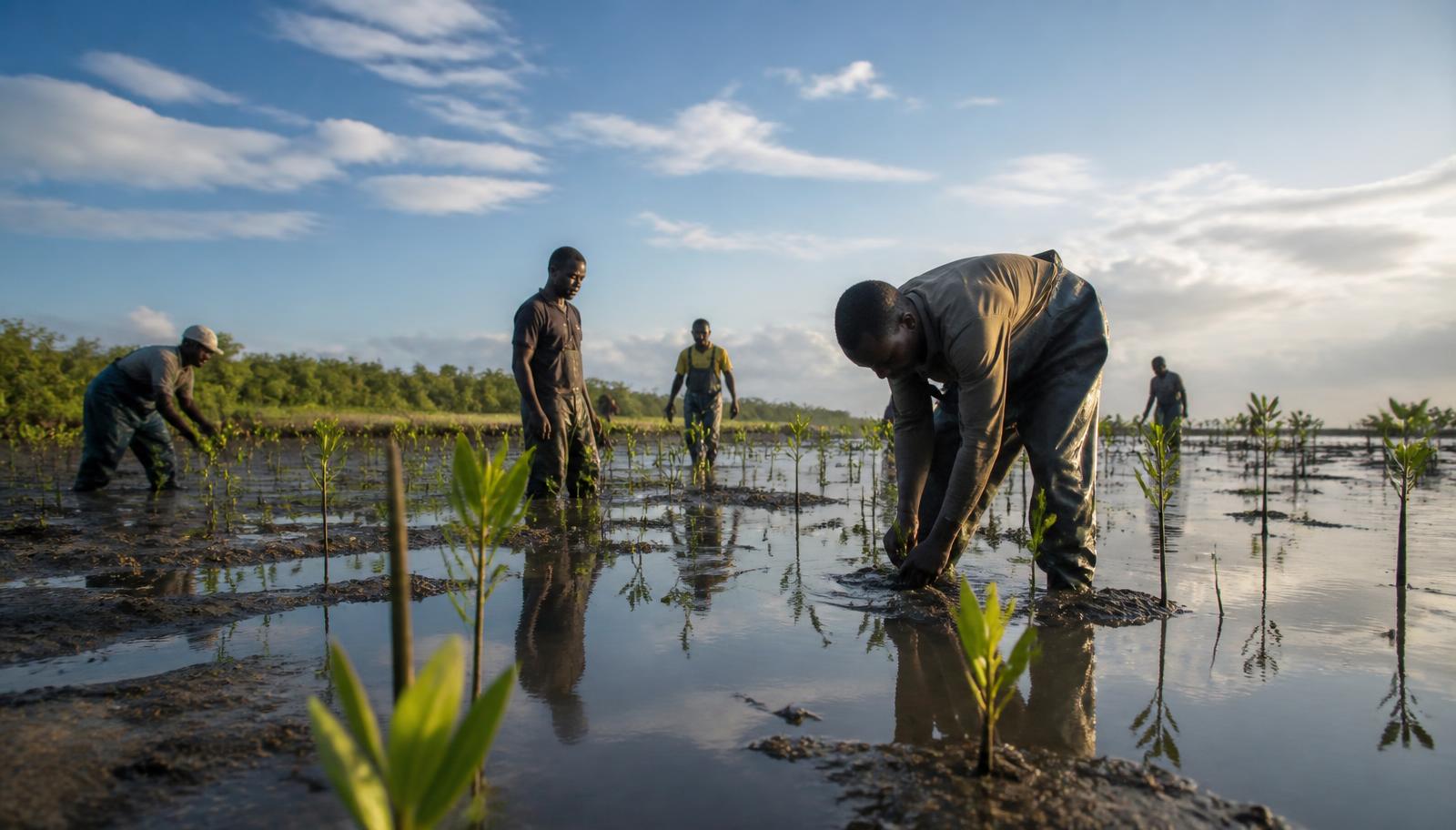
Oloibiri's wells were shut in decades ago. What remains is a marker, a plan for a museum and research centre, and a community whose condition is the strongest available argument against extraction without reinvestment. If the Oloibiri centre is built, it should be built as a working institution — an environmental monitoring and training campus with local employment — rather than as a plaque over a wound.
Honesty requires naming a second failure alongside the corporate one. The 13% derivation transferred to oil-producing states under section 162 of the Constitution is substantial, and its journey from state treasuries to riverine wards is frequently untraceable. Communities are right to demand direct, audited flows to local trusts, published spending, and independent verification. And the parallel debate — non-oil states, including Niger State, pressing for derivation on hydroelectric and solid-mineral revenue — is not an attack on the Delta. Applied consistently, a derivation principle that recognises every host of a national resource strengthens the Delta's own case rather than weakening it.
The Delta's argument has never been that it deserves more than others. It is that hosting the cost of national income should carry an enforceable right, wherever in Nigeria that cost is borne.
Proposal
A Shared Table: What a Settlement Would Look Like
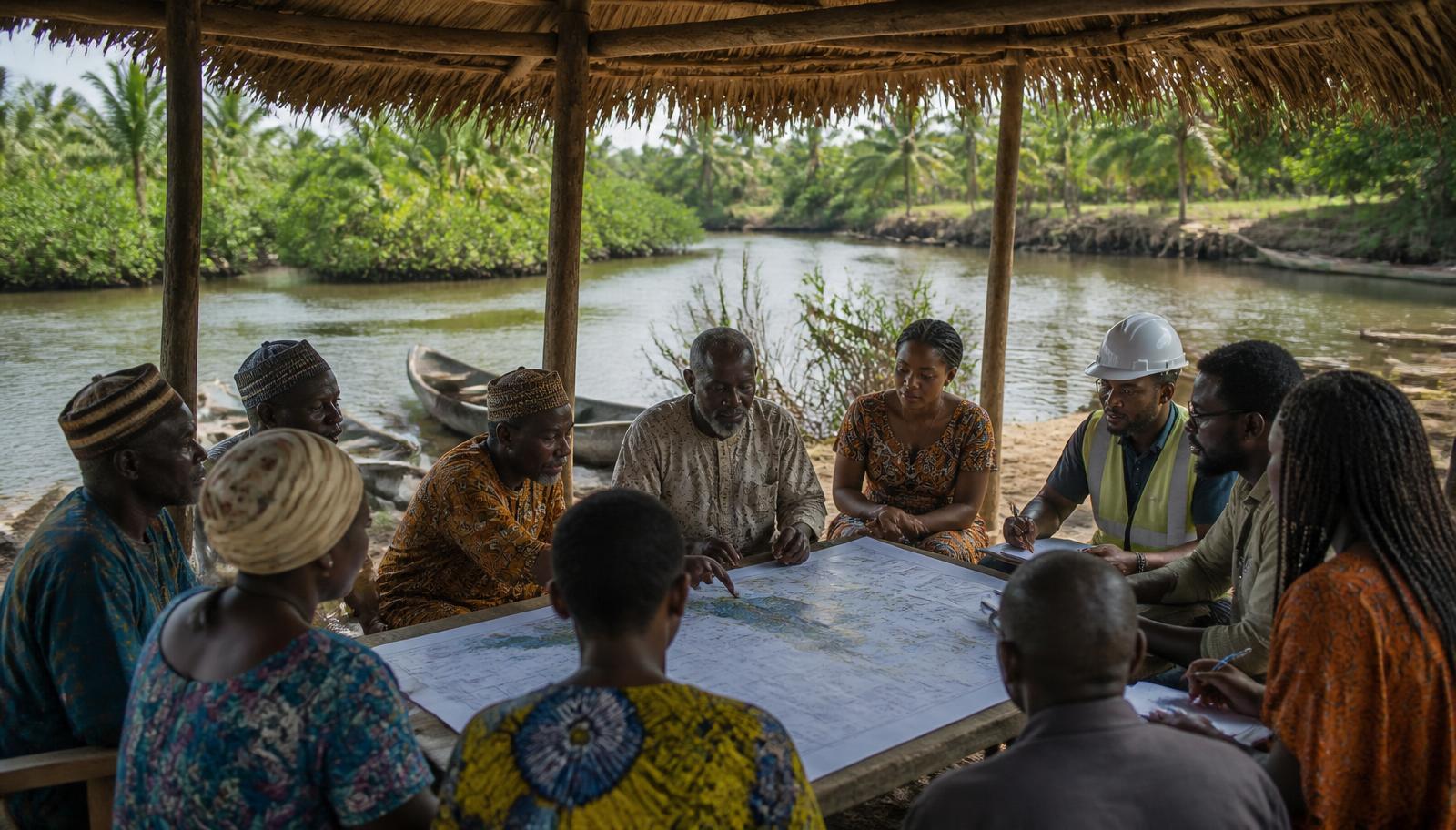
The confrontational frame has produced real victories, and it has limits. Court judgments allocate money; they do not by themselves rebuild a mangrove forest, staff a clinic, or restore trust between a company and the village at its fence line. What the region needs now is a negotiated settlement that no party can quietly walk away from — a Niger Delta Restoration Compact with defined obligations on every side.
Divesting international companies
Fund an independently administered legacy remediation endowment sized to verified contamination, with UNEP-standard baseline surveys, published clean-up milestones and third-party certification. Retain contractual responsibility for pre-completion damage rather than transferring it by silence.
Incoming Nigerian operators
Adopt the same disclosure and duty-of-care standard voluntarily: published spill data, independent joint investigation visits with genuine community participation, leak-detection on legacy trunk lines, and local procurement and engineering apprenticeships as contract terms, not charity.
Federal government and regulators
Amend the Land Use Act to restore compensable customary rights and extend compensation to long-term ecological loss. Narrow the PIA sabotage deduction to demonstrated complicity. Resource NOSDRA and NUPRC to enforce, and make divestment consent conditional on funded remediation.
State governments
Publish derivation receipts and expenditure line by line, and channel an agreed share directly to audited community development trusts with community-elected boards.
Host communities
Consolidate representation so operators face one legitimate, accountable interlocutor per cluster; protect infrastructure as shared assets; and hold trust boards to the same transparency standard demanded of everyone else.
Diaspora, civil society and academia
Supply what the compact needs to be credible — legal capacity, environmental science, monitoring technology, and patient capital for fisheries, aquaculture, mangrove restoration and the gas-to-power projects that could end flaring.
Why this is the pragmatic route
Every actor at that table has a self-interested reason to sign. Operators gain licence-to-operate stability and lower disruption cost. Regulators gain compliance they can actually measure. States gain investment that does not evaporate at the first blockade. Communities gain enforceable entitlements instead of discretionary goodwill. None of this requires anyone to pretend the past was fair; it requires everyone to agree the future will be documented.
Call to action
The Ask: Restoration, Not Retribution
The Ogale and Bille trial in London will be a landmark whichever way it resolves. But the more important outcome is one no court can order: a funded, independently supervised restoration programme agreed before the last onshore asset changes hands, covering every operator that profited from the basin and every authority that regulated it.
We therefore call on the divesting majors to endow legacy remediation rather than litigate it; on Renaissance and its peers to set a new domestic standard rather than inherit an old one; on the National Assembly to amend the Land Use Act and the PIA sabotage clause; on Delta state governments to publish every naira of derivation; and on our own communities and diaspora to organise with the discipline this moment demands.
Seventy years of extraction cannot be undone. A clean creek, a working fishery and a school with a roof can be built. That is the measure we are asking every party to be judged by — and the one we intend to keep publishing against.
Assets can be sold. Responsibility can only be discharged. Our invitation is to discharge it together, in public, on a timetable.