
Egbesu: The Law of the Leopard
Cosmology, history and the struggle for justice in Ijaw land
A justice deity that can only be called by the clean, the war canoes of 1895, the white-chalked youths of 1998, a scepter taken from a shrine in 2016, and a court that in 2026 ordered a demolished temple rebuilt.
Ask in the creeks what Egbesu is and you will not be told a story about a god. You will be told the rules. Who may call on it, and who may not. What a warrior must do the night before, and what will happen to him if he takes so much as a goat from a house he did not need to enter. Egbesu is the Ijaw arch-divinity of justice, and it is more law than legend.
That is why the word travelled so far in the 1990s, when the youths of the Niger Delta chalked their faces white and told the soldiers that the clean cannot be shot. It is why the same word sits over the entrance of a temple at Oporoza where monarchs still gather to give thanks, and why in 2026 a Federal High Court ordered a Pentecostal prophet to rebuild a shrine to it that his congregation had knocked down.
This article sets the record out in full and in order: the cosmology that places Egbesu under a Creator called Our Mother; the code that governs it; the priests who keep it; the war canoes of 1895; the Kaiama Declaration, Odi and the oil war; the raid on Oporoza; the ecological reading that many Ijaw now give it; and the stage on which its playwrights have rewritten tragedy. Every claim is tagged for how well it is supported, because a people's law deserves to be reported accurately.
King Koko's canoes strike the Royal Niger Company. The Company's charter ends five years later.
5,000 youths, 500 communities, 40 clans. The Supreme Egbesu Assembly is in the hall.
Government count to local estimate. A court later awarded the town 37.6 billion naira.
Damages ordered against a prophet whose church destroyed an Egbesu shrine.
The order of things
Egbesu is not at the top of the Ijaw universe. Knowing what sits above it, and beside it, is the first step to understanding what it is for.
Order runs from the Creator down to the living. Ijaw cosmology ranks by function and responsibility, not by family tree.
Egbesu
DocumentedArch-divinity of justice, defence and moral order
Egbesu is not a creek spirit and not an ancestor. It is a force of righteousness that can be called on only to defend or to correct a wrong, and only by people who are themselves clean. Ijaw custodians describe it as entrusted to the people by the Creator; the Courson and Odijie study describes a coherent just-war system with rules for when force is permitted, how it must be conducted and what must follow. Its emblems are the leopard, the panther and the lion: controlled ferocity, never unprovoked.
Leopard · white kaolin chalk · the sworn oath

The Creator delegates. That single fact organises everything below. Woyengi is not carved, not housed and not fed with daily sacrifice; the work of governing a wet, dangerous, fertile world is handed to the oru, and among them Egbesu holds one portfolio only. It does not raise the tide or fill the net. It judges. The water spirits that Robin Horton watched being danced back into Kalabari towns each season belong to a different department of the same government, and no Ijaw would confuse the two.
Two features of the cosmology explain the code that follows. First, the Creator is feminine, Our Mother, and holiness is associated with her whiteness: the chalk, the white worn at festivals. Second, each person carries a teme, a spiritual double that chose its destiny before birth. Justice therefore reaches inside the person. A shield that covers only the clean makes sense in a world where the soul, not the body, is the unit that counts.
The law of the leopard
Rules for when force is permitted, how it must be conducted, and what happens to those who break them. The closest thing in West Africa to a written just-war doctrine that was never written down.
Force only in defence, or to right a wrong
conditionEgbesu cannot be called to expand territory, to settle a personal score or to start a fight. Its power answers unprovoked attack and injustice. Custodians told Courson and Odijie that a war not sanctioned in this way simply has no Egbesu in it.
Parallel: Just cause (jus ad bellum)
Only the chief priest can sanction war
conditionEgbesu king · Okparan
The decision to fight is not an individual's. The Egbesu king, the chief priest, must sanction it; in his absence the Okparans, the high priests, may. This locates the authority to use force in a religious office rather than in grievance.
Parallel: Legitimate authority
The suppliant must be clean
conditionwhite chalk · confession · cleansing
Entrance to the shrine follows confession and cleansing. White chalk on the skin signals truth and transparency; a creed circulated among devotees sums the demand up as truth, justice and righteousness. A deceitful heart is believed to meet resistance in the grove itself, and unexpiated wrongs bar a person until restitution is made.
Parallel: Right intention · ritual purity
No killing of non-combatants
prohibitionThe shield covers a warrior facing an armed enemy. It is withdrawn from anyone who kills the unarmed, the old, women or children.
Parallel: Discrimination (jus in bello)
No rape
prohibitionSexual violence is named as a taboo that instantly forfeits protection. Abstinence and separation from menstruating women before battle appear in the same cluster of rules.
Parallel: Prohibited conduct
No looting, theft or plunder
prohibitionTaking civilian property turns a defensive war into a raid. Custodians say Egbesu leaves the looter at once.
Parallel: Proportionality · no pillage
No false oath, false witness or treason
prohibitionEgbesu is sworn upon. Lying under it, betraying the community or breaking an oath is treated as an attack on the deity itself.
Parallel: Good faith
No human sacrifice
prohibitionThe tradition as its custodians describe it relies on prayer, libation, animal offerings and clean intention. Colonial writers who called Egbesu a 'fetish' or 'cult' did not record human sacrifice in its rites.
Parallel: Sanctity of life
Break the code and the shield is gone
consequenceThe famous belief in invulnerability, including immunity to bullets, is conditional in every account. Adherents hold that the protection is real only for the clean; scholars record the belief as sincerely held and note that it explains, to believers, why some fighters fall. This page reports the belief; it does not test it.
Parallel: Sanction · loss of grace
Pick a case and test it against the four questions custodians say the priests ask. The answers follow the tradition as its custodians describe it, not our opinion.
Armed men land at dawn and burn houses. The chief priest is consulted; the warriors are cleansed and marked with chalk before they answer.
The famous part of the code is the shield: the belief that a warrior who keeps it cannot be harmed, and in the modern telling cannot be shot. Two things need saying plainly. It is a sincerely held belief, and it is conditional in every account. Believers explain a fallen fighter by a broken rule, not a failed god. Scholars record the belief without endorsing it, and so does this page. What is not in doubt is the moral architecture around it: a cause that must be just, an authority that must sanction, conduct that must stay clean. Elias Courson and Michael Odijie, whose 2020 study rests on interviews with priests and former fighters, found the structure close enough to the Western doctrine of just war to set the two side by side.
Priests, rites and the clan shrines
Egbesu is administered, not merely believed. A hierarchy decides, a set of rites cleanses, and every clan keeps its own house.
Egbesu king
Chief priest and living symbol of the deity
The only office that can ordinarily declare or sanction a just war.
Okparans
High priests
Also written Akparans. May sanction war in the chief priest's absence; nine of them formed the 2013 focus group behind the leading academic study.
Kulikuliwei
Priests and foot soldiers
The rank that carries the deity's rites onto the ground. Courson and Odijie warn that all three titles carry more in Izon than their English gloss.

The rites
The clan Egbesus
Custodians name a shrine for each of the great clans. The lists are theirs; the sites we could confirm are marked.
Seat of the Gbaraun Egbesu temple; the most public shrine today.
A temple with its own priesthood; treated in the companion IjawConnect essay on Egbesu philosophy.
Named by custodians among the clan Egbesus.
Named by custodians among the clan Egbesus.
Oral tradition regards Egbema Egbesu as especially potent.
The clan of Kaiama and Odi.
Amabolou in Ekeremor was reported as the Egbesu Boys' traditional headquarters.
Named in the same custodial lists; boundaries and sites vary by teller.
Akassa, 29 January 1895
The night the city-state of Nembe went to war with a chartered company, and what the delta remembers about who sent the canoes.
Sir George Goldie's Royal Niger Company held a charter from 1886 that let it tax, police and exclude. Its customs posts on the Niger cut the Nembe-Brass traders out of the palm-oil markets they had run for a century, and by 1894 the city-state faced hunger and smallpox behind a company blockade. King Frederick William Koko, Mingi VIII of Nembe, a Christian convert who returned to the old religion, gathered his war council.
Before dawn on 29 January 1895 about 1,500 men in some 22 war canoes fell on the Company's depot at Akassa on the Nun estuary. They destroyed the warehouses, the machinery and the customs house and carried off about seventy Company workers. In February a Royal Navy expedition bombarded and burned Nembe; estimates of the dead run into the hundreds. Koko was never taken. He died in exile in 1898, most accounts say by his own hand.
The Royal Niger Company receives its royal charter and begins excluding Nembe-Brass middlemen from the palm-oil markets up the Niger.
Company customs posts and gunboats tighten the blockade. Nembe traders face ruin; smallpox and hunger spread in the city-state.
King Frederick William Koko Mingi VIII of Nembe leads about 1,500 men in some 22 war canoes against the Company depot at Akassa before dawn. Warehouses, machinery and the customs house are destroyed; around 70 Company workers are taken.
A Royal Navy punitive expedition bombards and burns Nembe. Estimates of the dead run into the hundreds.
Sir John Kirk's inquiry records the Company's abuses. The Colonial Office begins to plan direct administration.
King Koko dies in exile, most accounts say by his own hand.
The Company's charter is revoked under the Royal Niger Company Act of 1899. The Niger Coast Protectorate becomes Southern Nigeria.
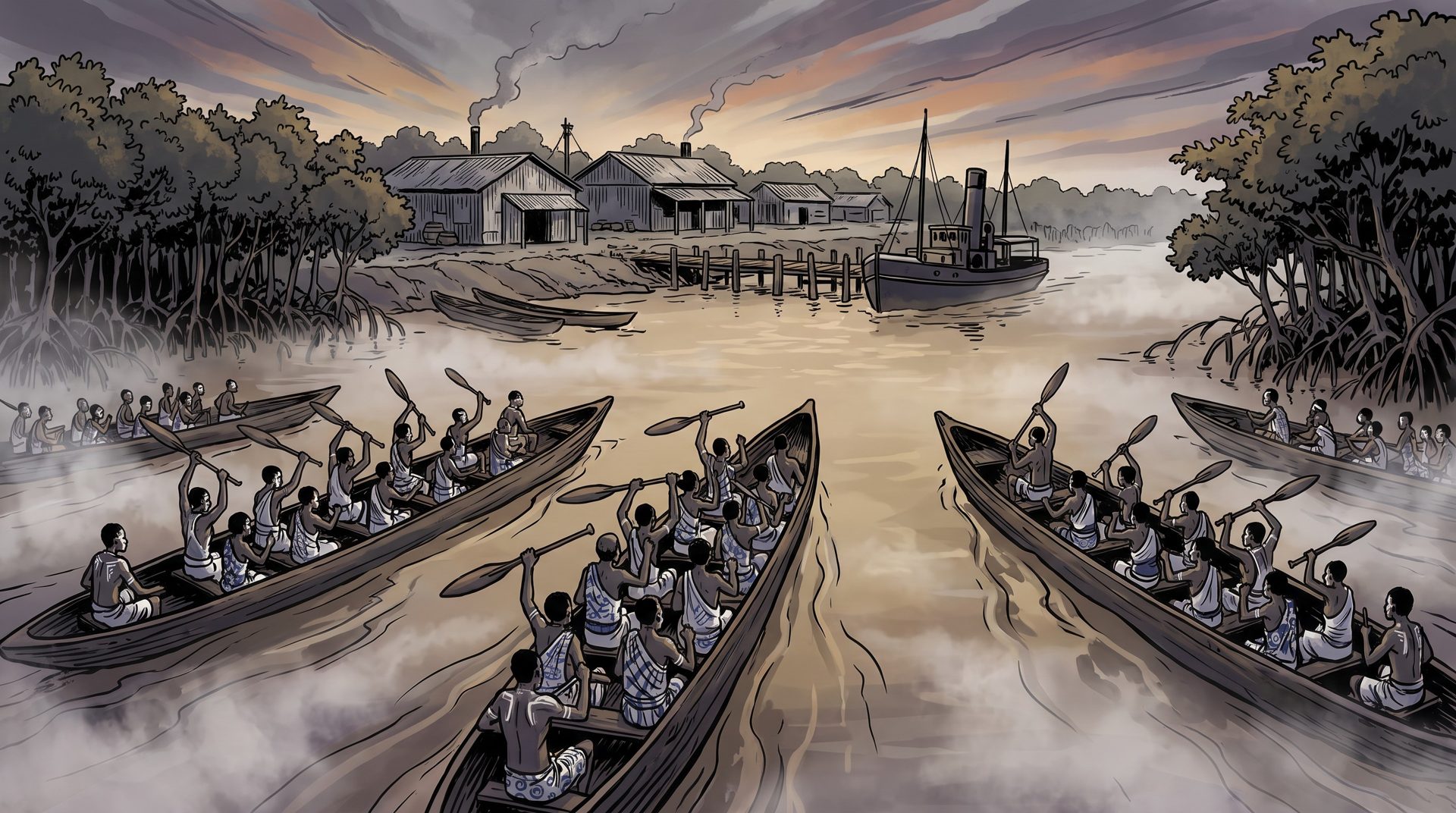
What Akassa did was expose chartered rule. Sir John Kirk's inquiry recorded the Company's abuses; the Colonial Office, already weighing cost and the rival Niger Coast Protectorate, moved toward direct administration. The charter ended on 1 January 1900 under the Royal Niger Company Act of the year before. Akassa was one cause among several. It was also the moment the delta proved that a company with gunboats could be made to answer.
And Egbesu? Nembe and wider Ijaw tradition hold that the canoes went out under it, oath-bound and cleansed. That is how the story is told at Twon-Brass and Nembe today, and it is why the raid sits in the Ijaw memory as the first modern proof of the leopard's law: a defensive war against economic strangulation, sanctioned, and won on its own terms even in defeat. We could not find the rite recorded in E. J. Alagoa's history of Nembe and so we report it for what it is, a tradition.
Egbesu rites and oaths preceded the raid
Ijaw tellers hold that the war canoes went out under Egbesu. We could not find the rite recorded in E. J. Alagoa's history of Nembe, The Small Brave City-State, and cite it as tradition.
British dead of 1895 lie at Twon-Brass
The 'White Man's Graveyard' at Ada-Ama, Twon-Brass is a real cemetery and a local heritage site. Its link to the 1895 dead rests on local tradition and heritage reporting rather than a published register.
The Kaiama Declaration was a secessionist document
Resolution 10 says the opposite in terms: “We agreed to remain within Nigeria but to demand and work for Self Government and resource control for the Ijaw people. Conference approved that the best way for Nigeria is a federation of ethnic nationalities.” The attendance figure usually given, five thousand, appears neither in the Declaration nor in the Human Rights Watch report it is normally sourced to.
Akassa forced the charter's revocation
Historians treat the raid as one of the events that discredited chartered-company rule, alongside cost and rivalry with the Protectorate. It was a cause, not the sole cause.
Oil and the creeks, 1966 – 2026
How a justice deity became the banner of a resource war, what it sanctioned, what it did not, and where the shrine stands now.
The Kaiama Declaration
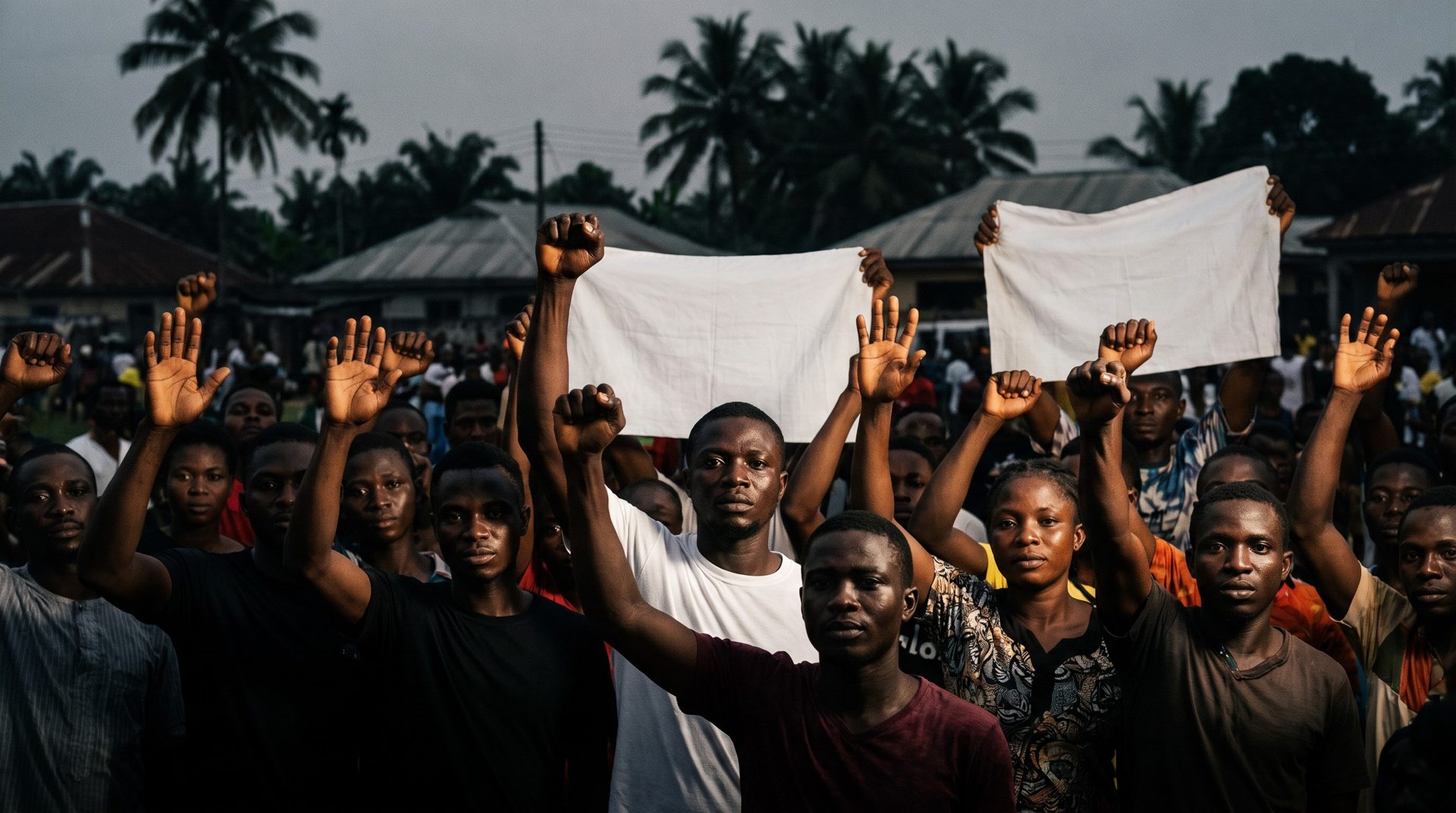
Ijaw youths from over 500 communities and more than 40 clans, representing 25 organisations, meet in Boro’s home town as the All Ijaw Youths Conference. They declare that all land and resources in Ijaw territory belong to Ijaw communities, demand the withdrawal of the military, and resolve at the close to found the Ijaw Youth Council — Felix Tuodolo its first president. Resolution 10 is the one usually forgotten: the conference agreed to remain within Nigeria, demanding self-government and resource control inside a federation of ethnic nationalities. Where Boro declared a republic, Kaiama expressly declined to.
The revival was deliberate. Youth leaders later described a conscious re-awakening of the Egbesu institution from 1997, and the Supreme Egbesu Assembly, a pan-Ijaw body that says membership is by birth, sat in the hall at Kaiama and came to be called the Ijaw Youth Council's spiritual arm. When soldiers fired on the ogele procession in Yenagoa on 30 December 1998 the marchers were chalked white. Odi, eleven months later, turned a movement into an insurgency.
Then the code met the creeks. The Egbesu Boys of Africa had no single command; refugee-board researchers found them loosely organised and warned that press accounts of a bulletproof cult were often unreliable. The same reports record kidnappings of oil workers, sabotage and crimes against civilians. Custodians told Courson and Odijie that Egbesu was invoked for resource control, self-determination, oil bunkering and extortion alike, depending on the circumstances, interests and space. By the tradition's own rule, the shield does not cover the second half of that list. That is the balance this page insists on: the tradition is real and old, and it was also selectively amplified and at times abused, by warlords and by a press that found the story irresistible.
The Movement for the Emancipation of the Niger Delta announced itself in January 2006 and cut national output from about 2.2 million barrels a day to about 1.3 million at the low point of 2009. President Yar'Adua's amnesty, announced on 25 June 2009 with a disarmament window from 6 August to 4 October, turned the spiritual insurgency into a stipend economy and, within a decade, into pipeline-surveillance contracts for former commanders. Whether that honoured the law of the leopard or hollowed it is argued in the creeks to this day.
Oporoza and the Gbaraun Egbesu temple
Where the deity has a public address, a monarch at its festivals, and a grievance against the Nigerian state.
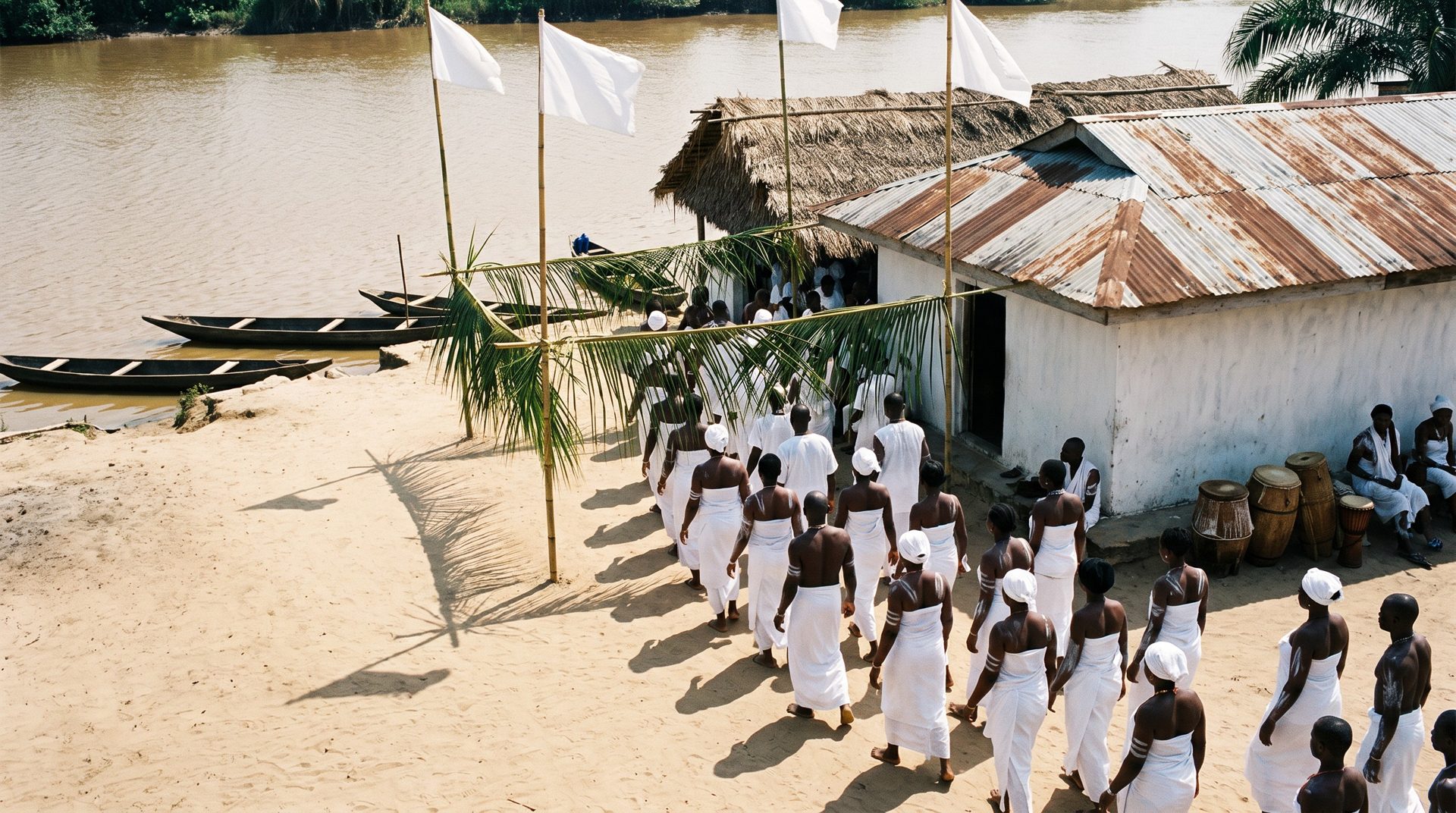
Gbaramatu Kingdom sits in the western creeks of Warri South-West, Delta State, and its traditional headquarters, Oporoza, houses the Gbaraun Egbesu temple. Its monarch is the Pere, since March 2016 His Royal Majesty Oboro Gbaraun II, Aketekpe, Agadagba, the twenty-sixth to hold the stool. The temple is the most public Egbesu shrine in the delta: a working religious institution with an annual thanksgiving that draws Ijaw monarchs from across the region, most recently in December 2025.
It is also the spiritual home of Government Ekpemupolo, Tompolo, the Gbaramatu commander who led MEND's western wing and accepted the 2009 amnesty. Nigerian press describe him as the shrine's chief priest; the title recurs in Vanguard, TheCable and the kingdom's own Gbaramatu Voice, and we report it as such while noting that it is a title asserted in journalism rather than recorded by an ethnographer.
On 28 May 2016, hunting the Niger Delta Avengers and Tompolo himself, soldiers entered Oporoza, placed the Pere under house arrest for a week and went into the shrine. The kingdom says a golden sword, its Symbol of Authority, was taken with other ritual objects. Tompolo's open letters to President Buhari in June and July 2016 called it a desecration and asserted his constitutional freedom of worship: the scepter, he wrote, was a religious emblem of the Gbaramatu people, not a weapon. The army's own account differs, and the regalia's return was still being demanded a month later.
On 19 October 2020, after some six years out of public view, Tompolo reappeared at the shrine to lead days of thanksgiving and cleansing. The temple has been a public institution since. It is here, more than anywhere, that the deity's three modern faces meet: spiritual authority, community leadership and a running argument with the state about who owns the creeks.
Ojobo, 2024 – 2026
A Pentecostal prophet and congregation demolished the Osuopele Benesede Opu-Oru Egbesu shrine at Ojobo. The Izon Cultural Heritage Council sued. The Federal High Court in Warri ordered 205 million naira in damages, the shrine rebuilt and a public apology.
DocumentedThe creek as covenant
Why many Ijaw now read an oil spill as a breach of cosmic order, and what that reading asks of Egbesu.

Ijaw cosmology does not separate the creek from the people who fish it or the spirits who own it. The owu live in the water; the ancestors are buried on the land; a clan's oru is housed in a grove. Damage to any of them is damage to a relationship, not to a resource. That is the ground on which a growing body of Niger Delta writing, from the ecopoetry studied in the Journal of the British Academy to the revivalist Egbesu Brotherhood of Ijaw land, reads oil pollution as more than an economic loss: as a violation of the order the Creator delegated, and so as a wrong that Egbesu exists to correct.
Two cautions. This eco-spiritual reading is a modern articulation, made by Ijaw writers and custodians in the last thirty years; the older sources describe Egbesu's domain as justice and war, not ecology, and we do not want to put a twenty-first-century vocabulary into nineteenth-century mouths. And the code still applies. A polluted creek is a just cause, but the tradition judges conduct separately, and it has never blessed ransom or bunkering as a means of restitution.
What the reading does give the delta is a language of stewardship with authority behind it. The same communities that guard sacred creeks and totem animals, and that have pulled the Niger Delta red colobus back from the edge, are the communities that keep Egbesu's shrines. Indigenous law and indigenous conservation are, in the creeks, the same institution wearing two names.
Creeks and lakes under an oru are closed to fishing or to certain nets. Breaking the closure is a spiritual offence before it is a legal one.
Clans that hold a leopard, python or manatee as totem do not kill it. The Apoi red colobus survives partly because of this.
Gas flares, spills and dredged canals become, in this reading, an injury to the covenant, and therefore a matter for Egbesu's justice.
A tragedy in which the community wins
Niger Delta playwrights have used Egbesu to rewrite the oldest rule of tragic theatre: that the hero must fall.
Righteousness as a redemptive force
Protagonists suffer in a struggle with oppressive power, but the community keeps its moral agency, breaks the subjugation and restores harmony.
Collective redemption; the flaw lies with the oppressor.
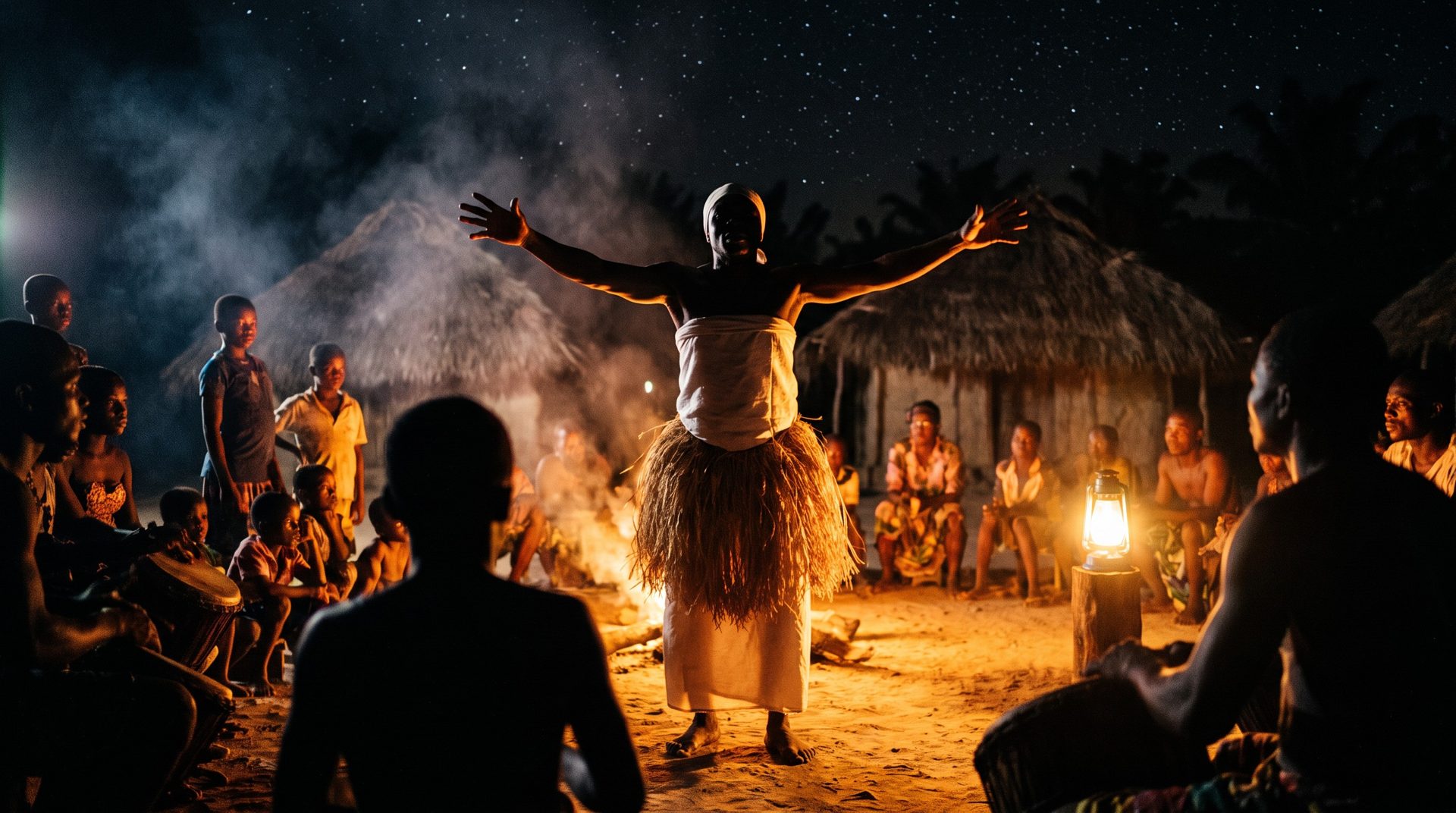
In Aristotle the hero falls through a flaw. In Arthur Miller an ordinary man is crushed by a society that will not grant him his place. In Wole Soyinka the protagonist crosses the abyss of transition, as Ogun did, and is torn apart so that the community can pass. Victor Ihidero, writing in the Journal of African Cultural Studies on the plays of Barclays Ayakoroma and Benedict Binebai, argues that Ijaw restoration theatre does something none of these do. Its protagonists suffer, but the community keeps its moral agency, breaks the oppressor and restores harmony. The flaw belongs to the oppressor. Egbesu, in his phrase, is the revolutionary god-hero, the alter ego of Soyinka's Ogun.
The plays are real and staged: Ayakoroma's Dance on His Grave, A Chance to Survive and Castle in the Air; Binebai's Legend of Egbesu and Drums of the Delta. In prose, Ekanpou Enewaridideke's novel Spiked Beyond Spikes gives the deity to a nuclear physicist who calls on it for his revolution. Behind them all stands the Ozidi Saga, J. P. Clark-Bekederemo's transcription of Okabou Ojobolo's seven-night performance, an epic of vengeance bounded by justice and of a polluted community cleansed. Ozidi is not an Egbesu story, but it is the cultural soil in which the Egbesu model of tragedy grew.
Authentic tradition, and its instrumentalisation
Scholars agree the 1990s revival drew on real cosmology. They disagree on how to read it. Both the authenticity and the abuse are real, and neither cancels the other.
An old just-war philosophy
Elias Courson & Michael Odijie (2020)
Drawing on interviews with custodians, former fighters and a 2013 focus group of nine Okparans, they argue Egbesu is a coherent, pre-existing just-war system with criteria comparable to jus ad bellum, jus in bello and jus post bellum. The promise of victory, expressed as bullet-immunity, is the reward element internal to that ethic, not a modern invention.
Caveat. They concede that the 1990s appropriation 'shows little coordination' and served causes from self-determination to extortion.
The delta is overwhelmingly Christian, and increasingly Pentecostal. The region's own Christian history runs deep: the Kalabari prophet Garrick Sokari Braide led a mass revival in 1915 and 1916 that burned charms and emptied shrines before the colonial government arrested him. Pentecostal preaching often treats the old deities as idols or as spiritually dangerous, and the Ojobo demolition shows where that can lead. Yet traditional cosmology persists, often alongside church membership, in the deep-creek communities and in the conscious revival of festivals and shrines as heritage. This article is written for that readership: Ijaw Christians can study Egbesu as their own inheritance and law without being asked to worship it, and devotees can find it reported without mockery.
The claims ledger
Egbesu is a justice deity whose force is lawful only in defence or to correct a wrong
Courson & Odijie 2020; consistent across custodian interviews and older ethnography.
Hierarchy of Egbesu king, Okparans and Kulikuliwei
Recorded by Courson & Odijie from priests themselves.
Exactly nine clan Egbesus
The number nine in the literature is the size of a 2013 focus group of Okparans, not a doctrine. Custodial lists of clan Egbesus vary.
Warriors who keep the code cannot be harmed by bullets
Sincerely held, conditional belief. Reported here as belief; scholars record it without endorsing it.
Egbesu rites preceded the Akassa raid of 1895
Told by Nembe and wider Ijaw tradition; not found in Alagoa's published history of Nembe.
The Creator is feminine: Woyengi, 'our mother'
Okara and Beier's recorded creation narrative; Ijaw religious studies on AJOL.
The word 'Egbesu' has a known etymology
No linguist has published one. The reading from 'suo', 'deity', as in the Apoi title Kalasuo, 'small god', is folk etymology; the reading from Yoruba egbe, 'body', is a cross-language guess.
Tompolo is chief priest of the Gbaraun Egbesu shrine
Described so repeatedly by Vanguard, TheCable and Gbaramatu Voice; a press title rather than an anthropological one.
Soldiers seized the shrine's Symbol of Authority in May 2016
Reported by TheCable and Gbaramatu Voice with Tompolo's letters to the President; the army's own account differs.
Egbesu drama inverts classical tragedy
Victor Ihidero's 'Ijaw Mythology and New Humanist Tragedy' (Journal of African Cultural Studies) reads Binebai's and Ayakoroma's plays this way and calls Egbesu the alter ego of Soyinka's Ogun.
A Pentecostal congregation destroyed an Egbesu shrine at Ojobo and was ordered to pay 205 million naira
Federal High Court, Warri, 2026, after a suit by the Izon Cultural Heritage Council.
Egbesu Boys committed kidnappings and crimes against civilians
Immigration and Refugee Board of Canada 2000 and 2006; United States EOIR country file.
Human sacrifice formed no part of Egbesu rites
Custodians are emphatic; colonial sources hostile to the cult do not record it either.
Glossary
Izon and eastern Ijaw terms used on this page. Only words we could attest are listed.
'Our mother'; the Creator in central and western Izon.
The Creator in the eastern delta: Kalabari, Okrika, Nembe.
God; a second Izon name for the Creator.
Deity, spirit; also a place rich in fish.
Water spirit; also the masquerade that embodies one.
A person's soul or spiritual double.
Clan; the unit that keeps its own Egbesu.
High priest of Egbesu (also Akparan).
Priest-soldier; the deity's foot rank.
Procession of drums, song and dance; the form the December 1998 marches took.
A metal ritual object carried in Egbesu rites to test and discipline youths.
Interrogation of a corpse to learn the cause of death.
King; the title of the Gbaramatu monarch.
King; the title used at Nembe, Bonny, Kalabari and Okrika.
On the word Egbesu itself: no linguist has published an etymology, and we do not offer one. Several words that circulate online as Izon terms for taboo, purity or chalk could not be found in the Kolokuma Izon dictionary and are not used here.
- 1.Courson, E. & Odijie, M. (2020). Egbesu: An African Just War Philosophy and Practice. Journal of African Cultural Studies 32(4), 493–508.
- 2.Omeje, K. (2005). The Egbesu and Bakassi Boys: African Spiritism and the Mystical Re-traditionalisation of Security. In D. J. Francis (ed.), Civil Militia. Ashgate.
- 3.Ifeka, C. (2006). Youth Cultures & the Fetishization of Violence in Nigeria. Review of African Political Economy 33(110), 721–736.
- 4.Human Rights Watch (1999). The Destruction of Odi and Rape in Choba.
- 5.Human Rights Watch (1998). State of Emergency Declared in Niger Delta.
- 6.Immigration and Refugee Board of Canada (2006). NGA101034.E: Egbesu Boys; leadership, membership, recruitment, activities and treatment by authorities.
- 7.Immigration and Refugee Board of Canada (2000). NGA34309.E: Egbesu 'Boys' or 'cult'.
- 8.Library of Congress (2013). Nigeria: Government Ordered to Pay Local Community (Odi judgment).
- 9.Vanguard (2014). 15 years after massacre, Odi boils (the 15 billion naira settlement).
- 10.TheCable (2016). Tompolo: soldiers desecrated shrine, seized god's symbol of authority.
- 11.Gbaramatu Voice (2020). Tompolo appears again after six years out of public.
- 12.Vanguard (2016). Jubilation as Gbaramatu crowns Ogoba as 26th Pere.
- 13.Council on Foreign Relations. Recovery of Nigeria's oil production under threat (output during the insurgency).
- 14.Alagoa, E. J. (1964). The Small Brave City-State: A History of Nembe-Brass in the Niger Delta. Ibadan University Press.
- 15.Horton, R. (1962). The Kalabari World-View: An Outline and Interpretation. Africa 32(3).
- 16.Okara, G. in Beier, U. (ed.) (1966). The Origin of Life and Death: African Creation Myths (the Woyengi and Ogboinba narrative). Heinemann.
- 17.Clark-Bekederemo, J. P. (1977). The Ozidi Saga. Ibadan University Press / Oxford University Press.
- 18.Ihidero, V. Ijaw Mythology and New Humanist Tragedy: Theorizing Drama from the Delta. Journal of African Cultural Studies.
- 19.Rejuvenating African Traditional Beliefs in the 21st Century: An Example of the Egbesu Brotherhood of Ijaw Land.
- 20.Warri Sentinel (2026). Court orders prophet to rebuild demolished shrine, pay 205 million naira in damages (Ojobo).
- 21.Dictionary of African Christian Biography. Garrick Sokari Braide.
- 22.Williamson, K. & Blench, R. Dictionary of Kolokuma Izon.
- 23.Kaiama Declaration (11 December 1998), full text.
- 24.AJOL: An overview of Niger-Delta indigenous religions (LWATI).
About this article. Researched and written by the IjawConnect Editorial Board with two independent fact-checking passes against primary and academic sources. Where a claim rests on oral tradition it is labelled as such; where we could not verify a widely repeated claim, we say so rather than repeat it. The images are AI-generated interpretive plates made for this feature and are not photographs of real events, shrines or people. Belief in Egbesu's protection is reported as a sincerely held belief; nothing here tests or endorses it. Corrections from custodians, priests and scholars are welcome through the IjawConnect submission page.