
In the labyrinthine creeks of the Niger Delta, where mangrove roots embrace the waters and the air hums with the ancient songs of the Ijaw, there exists a force older than kingdoms—Egbesu.
To outsiders, Egbesu is often mischaracterized as a "god of war." This is a profound misunderstanding. Egbesu is the deity of justice—the cosmic arbiter who sanctions righteous resistance while condemning unprovoked aggression. In a world where the Nigerian state has often failed to protect Ijaw communities from environmental devastation and political marginalization, Egbesu has become the spiritual backbone of a people's struggle for self-determination.
This article explores the philosophy of Egbesu through multiple dimensions: the ancient ethics of just war, the mysterious Obobo ritual of warrior purification, the tension between traditional religion and Christianity, and the role of Egbesu in modern political resistance.
The Feminine Divine: Woyingi
Before Egbesu, there is Woyingi—the Creator Mother who birthed the cosmos from the primordial waters. Unlike many world religions with male creator deities, Ijaw cosmology places the feminine at the origin of all existence.
Woyingi created humans from clay and gave each person the power to choose their destiny. This foundational belief in human agency underlies the Ijaw conception of justice: wrong choices invite consequences, right choices invite blessings.
Egbesu operates within this cosmic framework as the enforcer of Woyingi's moral order—ensuring that those who violate the sacred covenant between land, ancestors, and the living face divine retribution.

The Ethics of Just War
Jus ad Bellum in Ijaw Traditional Law
Long before Thomas Aquinas articulated the Western doctrine of "just war," the Ijaw had developed a sophisticated ethical framework governing when and how war could be waged. This framework, encoded in the worship of Egbesu, distinguishes between defensive warfare (sanctioned) and aggressive warfare (cursed).
Just War Ethics (Jus ad Bellum)
Under Egbesu's law, warfare is governed by strict ethical principles. Click each principle to explore the requirements, violations, and consequences.
Just Cause (Jus ad Bellum)
Sélé Timi
War is only permissible to defend the land or correct a grievous injustice. Aggression for conquest or plunder violates the divine law.
Warrior Purity (Ọtụ Bọ)
Ọtụ Bọ
Warriors must undergo purification rituals to ensure they are 'clean'—free from crimes like murder, theft, or adultery. Impure warriors bring defeat.
Proportional Response
Tọkọ Arị
The force used must be proportional to the offense. Excessive violence invokes the wrath of Egbesu against the perpetrators.
Community Consent
Arụ Wérí
War must be declared with the consent of the community elders and ratified by the traditional council. No single person can declare war alone.

"The warrior who fights for the land fights with Egbesu at his side. The warrior who fights for plunder fights alone—and will fall alone."
— Traditional Ijaw proverb, recorded in Nembe oral traditions
The Obobo Ritual
A sacred verification ceremony where Egbesu identifies impure warriors through a divinely-controlled metal instrument.

The Square of Truth
The Obobo's square shape represents Egbesu's impartial justice—equal on all four sides, showing no favor.
The Crisis of Spiritual Duality
When the Shrine Meets the Cathedral
The modern Ijaw monarch is a "dual man"—custodian of the Egbesu shrine on Friday, congregant of the Anglican church on Sunday. This compartmentalization has profound implications for the spiritual accountability of traditional rulers and the coherence of Ijaw resistance movements.
The Dual Amayanabo
The modern Ijaw monarch walks between two worlds—the sacred grove of Egbesu and the pews of the Christian church. Explore the implications of this spiritual compartmentalization.
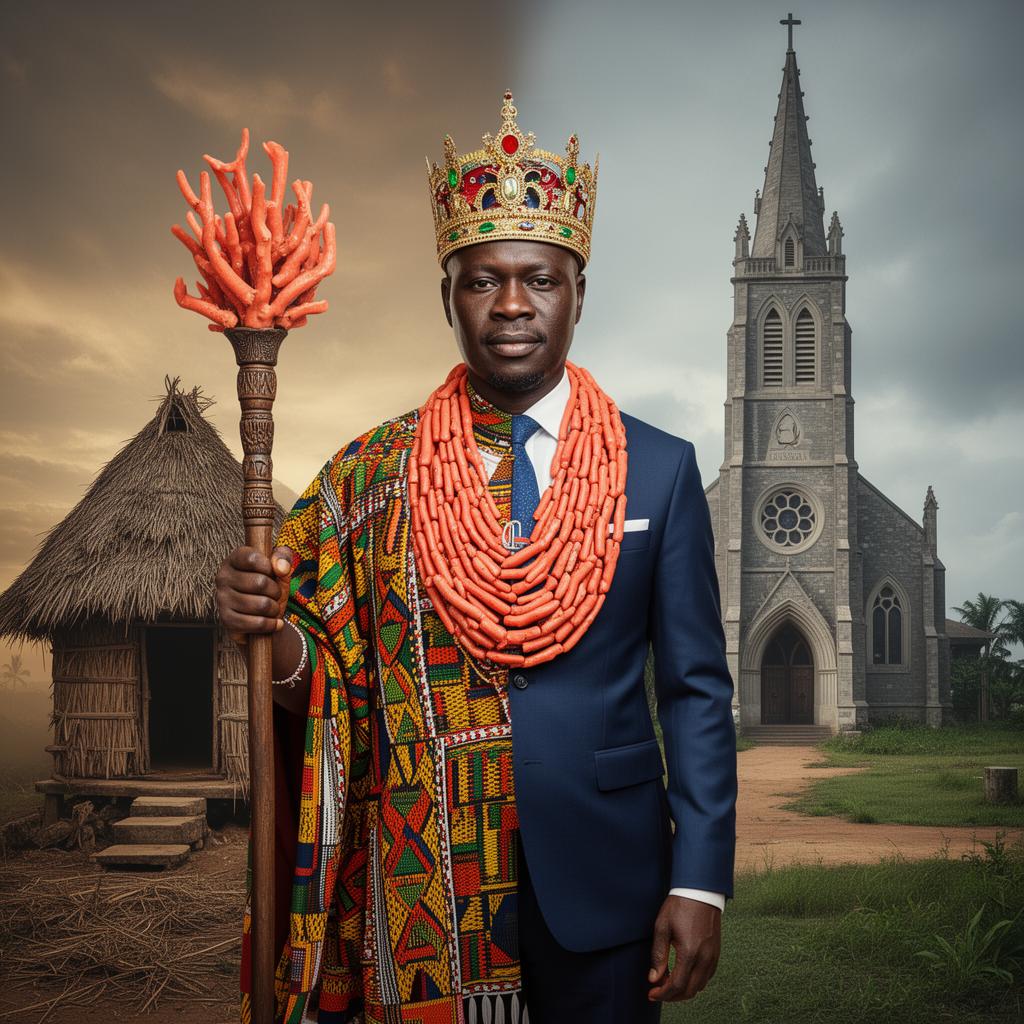
Click the icons on the image to explore the tension between traditional shrine accountability and modern church influence.
"One cannot serve two masters. The king's first duty is to the covenant of the land—the oath that binds him to Woyingi and Egbesu. To elevate the foreign god above the ancestors is to sever the cord that connects throne to territory."
— Traditional Elder, Nembe Kingdom
Egbesu as Counter-Balance
From Isaac Boro to MEND
In the contemporary era, Egbesu has served as a "counter-balance" to both tradition and modernity. While traditional monarchs may be seen as too compliant with the Nigerian state, youth-based Egbesu movements have used spiritual identity to legitimize armed resistance against environmental destruction and political marginalization.

Traditional fishing communities persist despite the encroachment of oil infrastructure—a visual metaphor for Ijaw resilience
Egbesu in the Age of Oil
From Isaac Boro to MEND, Egbesu has been invoked in every major Ijaw resistance movement. Trace the spiritual thread connecting six decades of struggle.
The Monarch as Security
Traditional Governance in Modern Nigeria
Despite the spiritual and legal challenges facing traditional institutions, the Ijaw monarchy remains the most effective grassroots security infrastructure in the Niger Delta. In regions where the Nigerian state is absent or mistrusted, the traditional ruler serves as mediator, judge, and peacekeeper.
The Monarch as Grassroots Security
In the absence of effective state presence, Ijaw traditional rulers remain the primary conflict resolution mechanism in the Niger Delta.
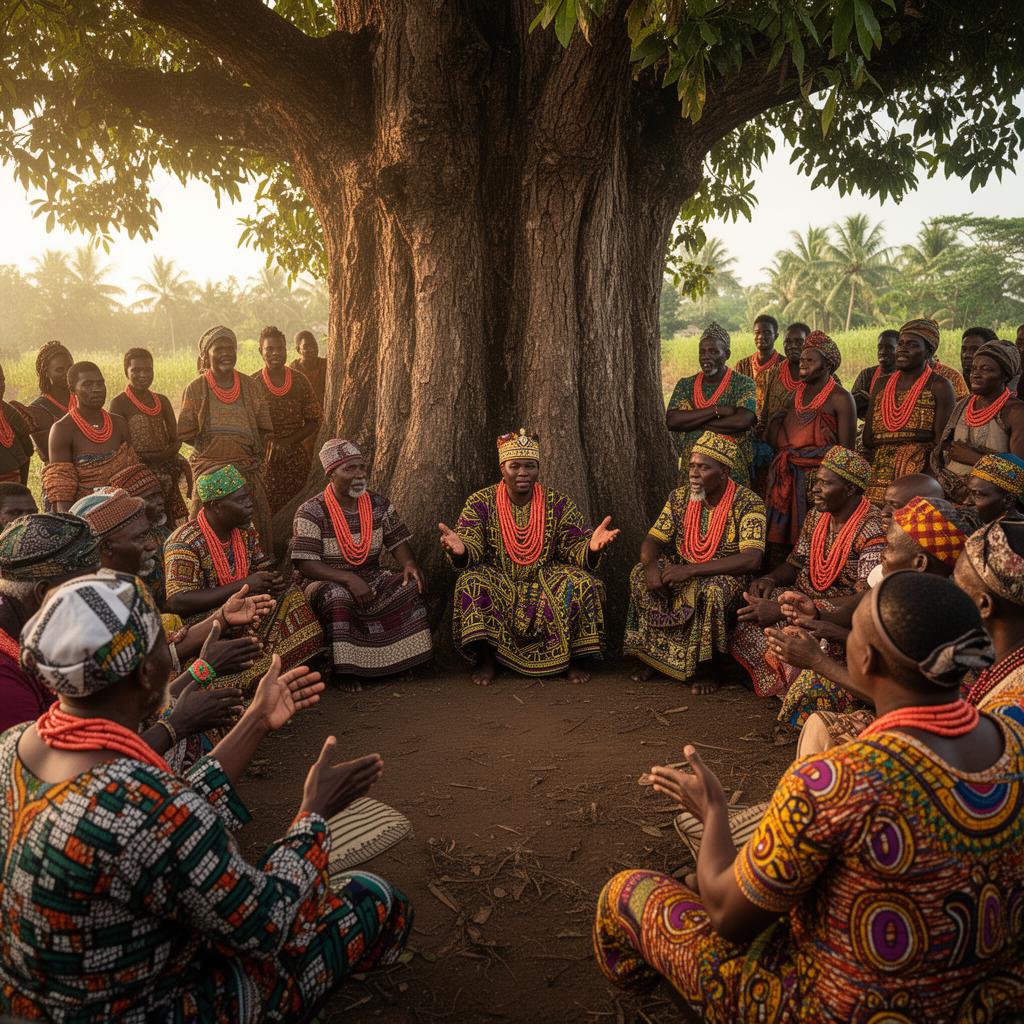
A traditional ruler mediating a land dispute under the sacred council tree
Ijaw Clans with Traditional Rulers
Local Disputes Resolved Traditionally
Average Traditional Resolution Time
Years in Nigerian Court System
| Aspect | Traditional Ruler | Nigerian State |
|---|---|---|
| Local Knowledge | Intimate knowledge of family histories, land claims, and ancestral disputes spanning generations | Limited knowledge; relies on documentation that may not exist for rural communities |
| Speed of Resolution | Can convene within hours; decisions made in days, not years | Cases can drag for 5-20 years in Nigerian courts |
| Community Acceptance | Decisions respected because rooted in ancestral authority and customary law | Often seen as external imposition; judgments frequently ignored |
| Enforcement Power | Limited to social ostracism and spiritual sanctions; no police force | Can deploy police and military, but often absent in remote areas |
| Corruption Risk | Spiritual sanctions deter corruption (fear of Egbesu); but still possible | Widespread judicial corruption; cases can be 'bought' |
| Inter-Ethnic Conflicts | Limited influence; may be seen as biased toward own community | Theoretically neutral; but often absent or poorly equipped |
The Resilience of the Covenant
The Ijaw monarchy, rooted in the cosmology of Woyingi and the ethics of Egbesu, has survived centuries of colonial and post-colonial trauma. While the "reverence to foreign gods" represents a significant challenge to the traditional covenant, the institution itself remains dynamic and resilient.
The throne is not furniture; it is a spiritual office.
Whether in the quiet groves of the Furupa Egbesu Temple or the crowded pews of a Yenagoa cathedral, the Amayanabo remains the "physical being" who bridges the gap between the divine and the mundane. The survival of the Ijaw nation depends on the continued strength of this covenant—a bond that is revealed through the land, affirmed by the ancestors, and sanctioned by the deities of the Niger Delta.

The Furupa Egbesu Temple—one of the most sacred sites in Ijaw spiritual geography
Continue Your Journey
Explore more of Ijaw spiritual heritage, history, and cultural preservation efforts.