
The laws this series calls the Gbori-gba are the moral "anchors" that keep a person's boat from capsizing in the currents of existence. If they are violated, the spiritual "wood" of a life becomes rotten — and in this telling the herbs lose their scent, the paddles lose their grip, and the soul is stranded short of the Water Mother.
"A broken taboo does not punish you immediately. It waits — like a crack in the hull — until you are far from shore."
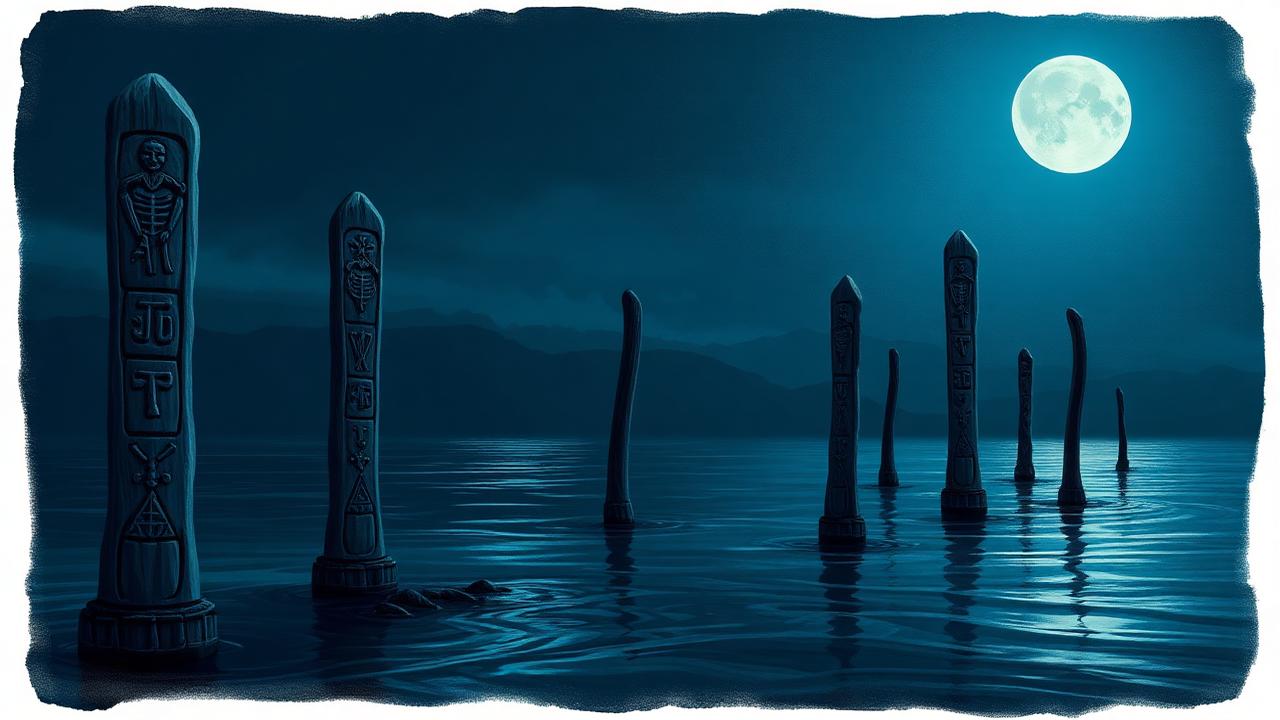
The Seven Laws
The Seven Taboos — Gbori-gba
"If broken, the paddle snaps — and the 13th Stroke fails."
The Blood-Water
(Adumu-Ma-Odua)The Law: Shedding the blood of a kinsman or an innocent on the water.
The Result: The Red fire of Egbesu turns against the offender. The paddle feels 'heavy' — the water refuses to carry a killer.
The False Oath
(Tọmọ-Kuro)The Law: Swearing a false oath by the name of Tamuno or the Ancestors.
The Result: The soul has no 'Truth-Weight' to stabilize the boat. It spins in circles, never reaching the horizon.
The Desecrated Boundary
(Egbe-Su-Pa)The Law: Stealing land, a wife, or the 'Destiny' of another.
The Result: The White light of clarity is extinguished. The offender becomes 'spiritually blind.'
The Poisoned Creek
(Diri-Biri)The Law: Using 'Black Medicine' to sink another's progress or health.
The Result: The scent of your life becomes 'foul' to the Adumu. Water Wisdom retreats.
The Abandoned Ancestor
(Dueni-Iya)The Law: Neglecting the burial rites or the memory of the parents.
The Result: No Ancestor waits at the 'Landing Beach.' You are 'homeless' in the afterlife.
The Arrogant Paddle
(Abiba-Ogono)The Law: Claiming that your success is yours alone, without acknowledging Tamuno.
The Result: The 'Breath' (Suọ) becomes thin. The soul is too 'light' to find the 'Current of Grace.'
The Hidden Heart
(Tubu-Biri)The Law: Concealing a 'Rotten Heart' while performing outward rituals.
The Result: Prayers never reach the Sky — they fall back like stones. The Bird refuses to plead your case.
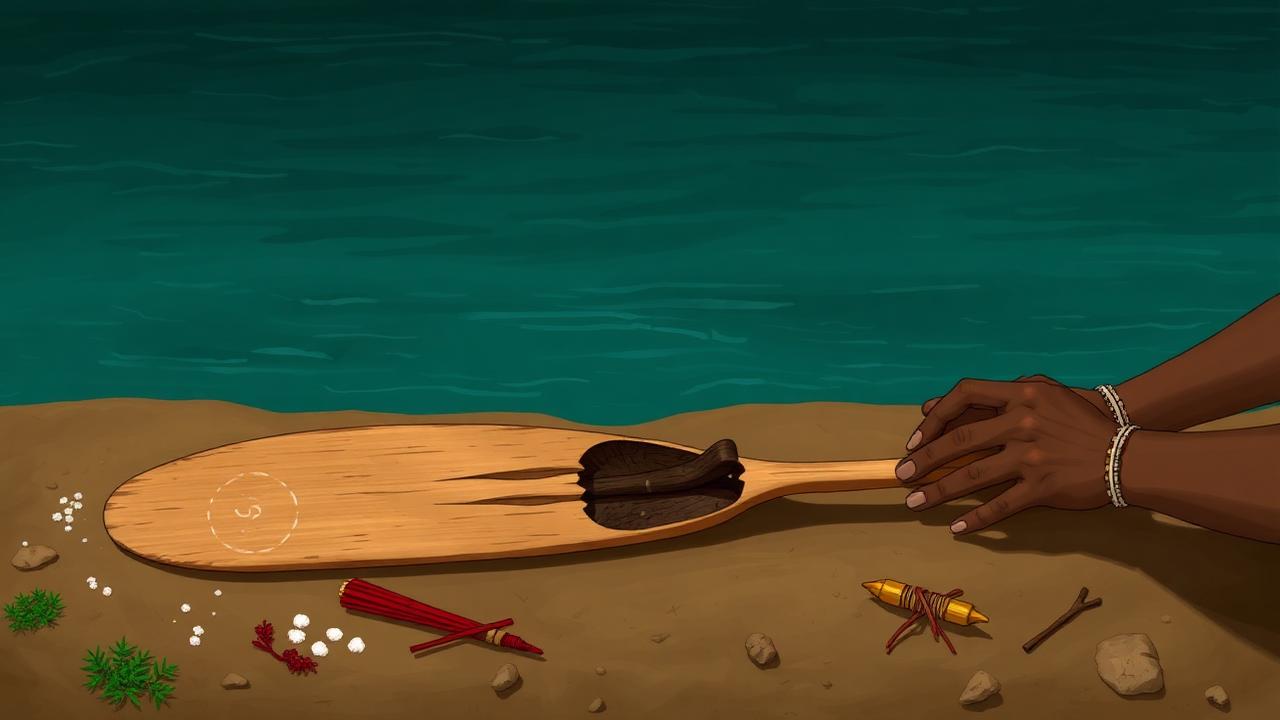
The Ritual of the Broken Paddle
When a grave offence is committed, this series describes a "Broken Paddle" ceremony:
The Act: A physical paddle is snapped in half over the water.
The Meaning: It signifies that the offender's "Will to Navigate" has been revoked by the community and the spirits.
The Restoration: To "fix the paddle," a rigorous process of purification and the payment of blood-debts is required before the offender is restored.
The ceremony as described is not merely punitive — it is redemptive. No soul is beyond repair, but the cost of restoration is proportional to the severity of the violation. The community participates because a "broken paddle" in one canoe weakens the entire fleet.

Synthesis
The Laws of the Creek ensure that the "Ritual Geometry" of the Ijaw nation remains intact. As long as the 7 Taboos are kept:
✦ The Colors remain bright.
✦ The Herbs remain fragrant.
✦ The Paddles remain strong.
✦ And the 13th Stroke will be as smooth as a python sliding into a deep pool.
What the corrections were checked against
Where a note on this page says a term "returns nothing", it means we could not find it in these works, in the Izon lexical sources, or in general search. Absence of evidence is not proof of invention — an oral tradition can be real and unpublished — but it does mean we cannot put it forward as documented.
Horton, R. (1962). “The Kalabari World-View: An Outline and Interpretation.” Africa 32(3), 197–220. — The four-level scheme, and the three classes of free spirit.
Horton, R. (1961). “Destiny and the Unconscious in West Africa.” Africa 31(2), 110–116. — Destiny as prenatal desire — what the spirit wanted, not what it was given.
Wariboko, N. (1999). “Counterfoil Choices in the Kalabari Life Cycle.” African Studies Quarterly 3(1), 3–21. — oju (body) and teme (spirit); duein, oru and owu; Owamekaso as head of the oru.
Tasie & Ofuru (2013), as cited in “African Names of God”, Niger Delta Journal of Gender, Peace & Conflict Studies 4(4), 2024. — Temearau and the Okrika Tamunoba as names of the Supreme Being.
Okara, G., and the recorded Woyengi–Ogboinba myth. — The created spirit chooses its own destiny, and is held to the choice.
Barley, N., and the museum literature on duein fubara (British Museum; Minneapolis Institute of Art). — so as the fate seated in the forehead; duein as the lineage dead.
Alagoa, E. J. (2005). A History of the Niger Delta. Onyoma Research Publications. — Delta political history, the canoe houses, and the Arogbo Agadagba.