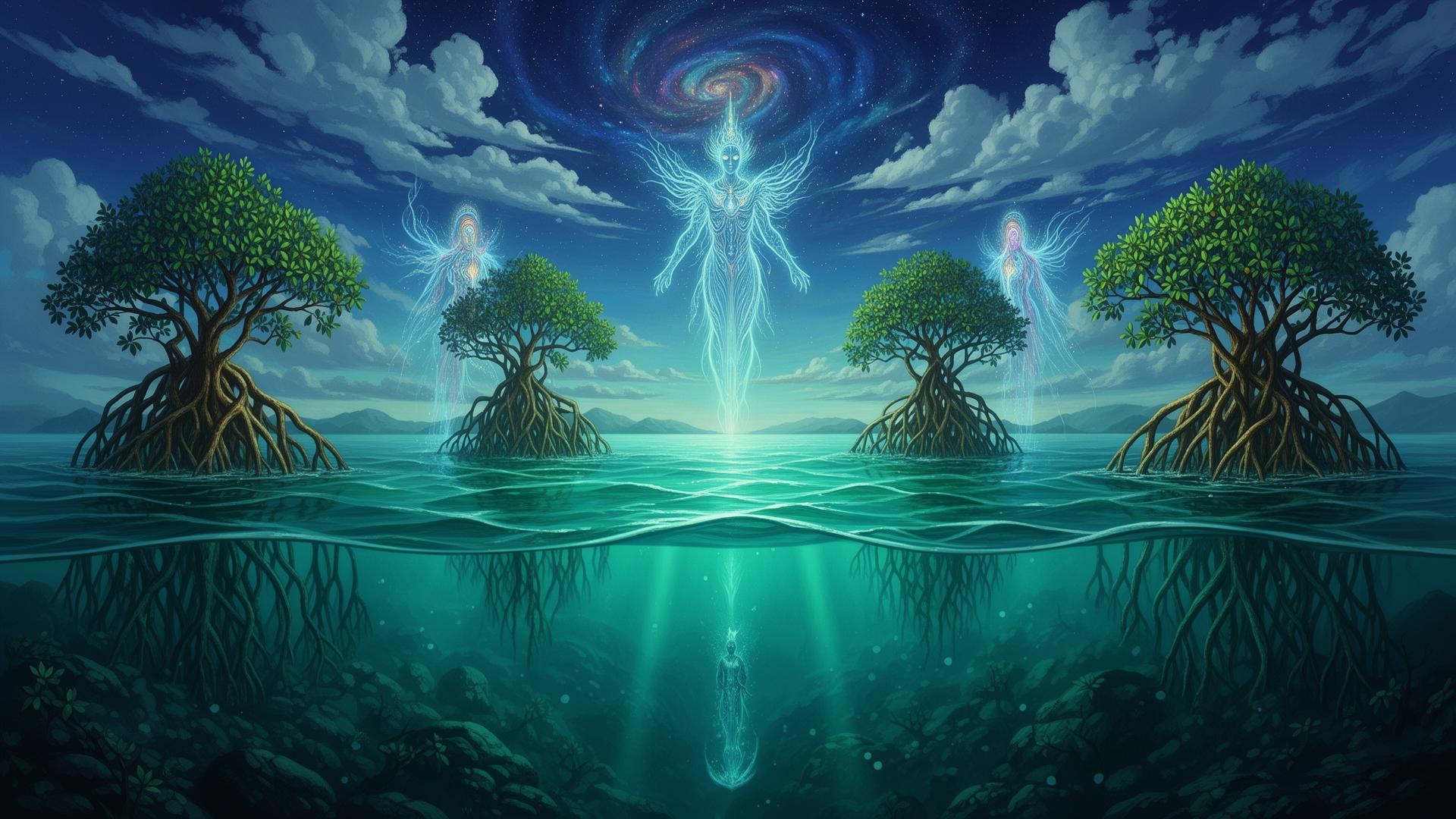
The spiritual architecture of the Ijaw (Izon) people is not a mythology in the Western sense — it is an operating system. A complete map of reality that explains the origin of the soul, the structure of the natural world, the rules of moral conduct, and the mechanics of death and rebirth. It predates the arrival of Abrahamic faiths in the Niger Delta by several millennia.
Central to this worldview is a Supreme Being who is predominantly perceived through a feminine lens, reflecting the primordial role of the "Mother" as the source of all existence. This deity is singular and absolute, yet known by various names — each name a functional key that activates a different dimension of the divine.
"We do not worship many gods. We worship One God who has many faces — just as the creek has many branches, but they all flow to the same ocean."
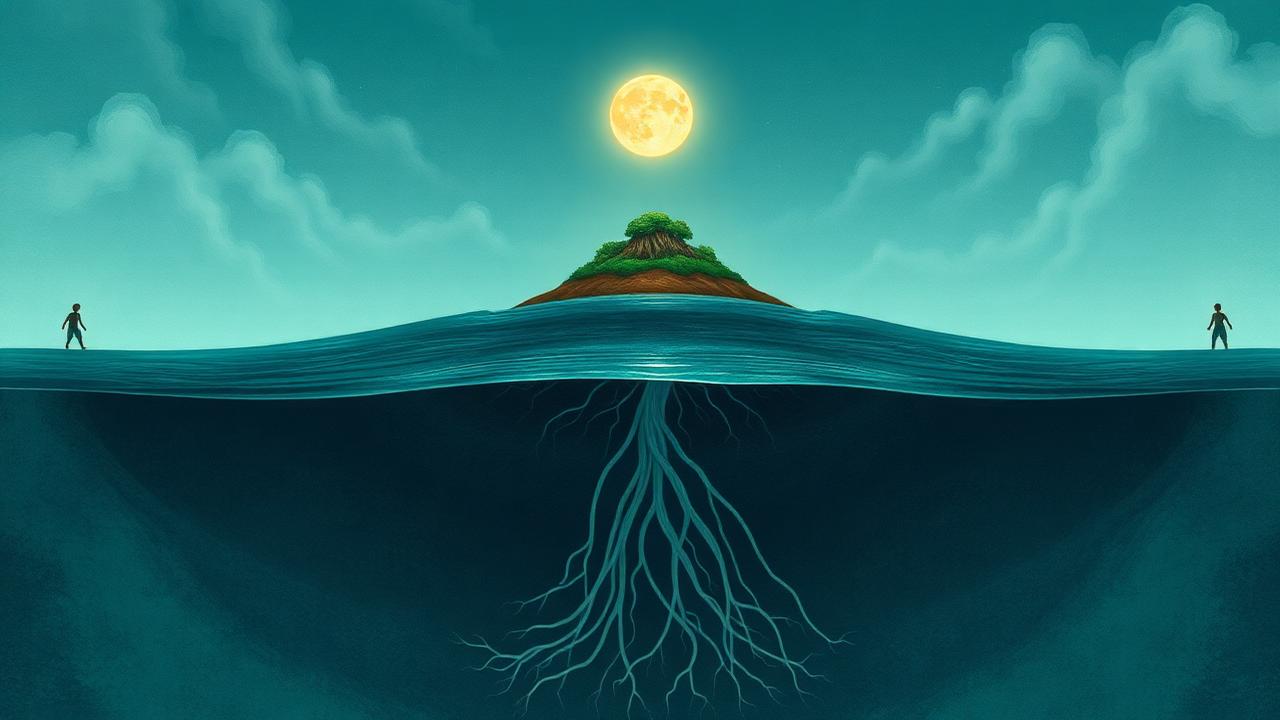
How the World Is Layered
This series pictures existence as strata of the delta itself, from the deep mud to the open sky. It is a vivid image. It is not, however, the scheme the ethnographers recorded, and the difference is worth stating before you read on.
The Descent, as This Series Draws It
Tamuno
— The Supreme CreatorThe unknowable source — 'The Planter who Moves and Hears'
Woyingi
— Our MotherThe feminine face of creation — the primordial womb
Oru
— The heroes who founded the townFree spirits of the founded community, headed by Owamekaso
Teme
— The Human SpiritThe individual soul — navigating the creeks of destiny
Kiri
— The Physical WorldEarth, water, mangrove — the 'Womb' we inhabit
"From Tamuno's breath to the creek's tide — and back again. The circle never breaks."
This series then reads the whole as cyclical: the soul descends from Tamuno through the Oru into the physical world, lives by the wisdom of Adumu, and returns through the 13th Stroke to the Water Mother — the "Circle of the Python." We could not find that cycle, or either of those names for it, in any published source. It is the series' own synthesis.

The Feminine Face of the Creator
Unlike many world religions that masculinize the divine, the Ijaw tradition places the Mother at the center of creation. Woyingi — "Our Mother" — is not merely a goddess among gods; she is God. The water is her womb. The creek is the umbilical cord. Birth is the entry into the physical "womb" (Teme-Biri), and death is the true birth into the real world.
The Teme-Biri Doctrine
The physical world is read here as a womb: we are embryos in the fluid of Tamuno, the creek is the umbilical cord, and death is not an end but the birth into the real world. Ayiba "takes" life the way a midwife cuts a cord.

The Doctrine of Oru
The term oru (or horu) describes a category of spiritual entities that are not independent of God but are the "forms of God" used in the administration of the universe.
The water spirits, known as Owuamapu, are a specific class of Oru that reside in the creeks and rivers. They have personalities, strengths, and weaknesses. Human spirits are said to dwell with the Owuamapu before being birthed into the physical world.
During festivals like the Owu-Oge, the community interacts with these nature forces. Dancers who don the carved wooden masks of the Owu become "alive" with the spirit of the Oru when the drums — which act as a form of sacred speech — begin to communicate with the subconscious mind. This system serves to "civilize the animal within," transforming primitive impulses into vehicles for spiritual enlightenment and social harmony.
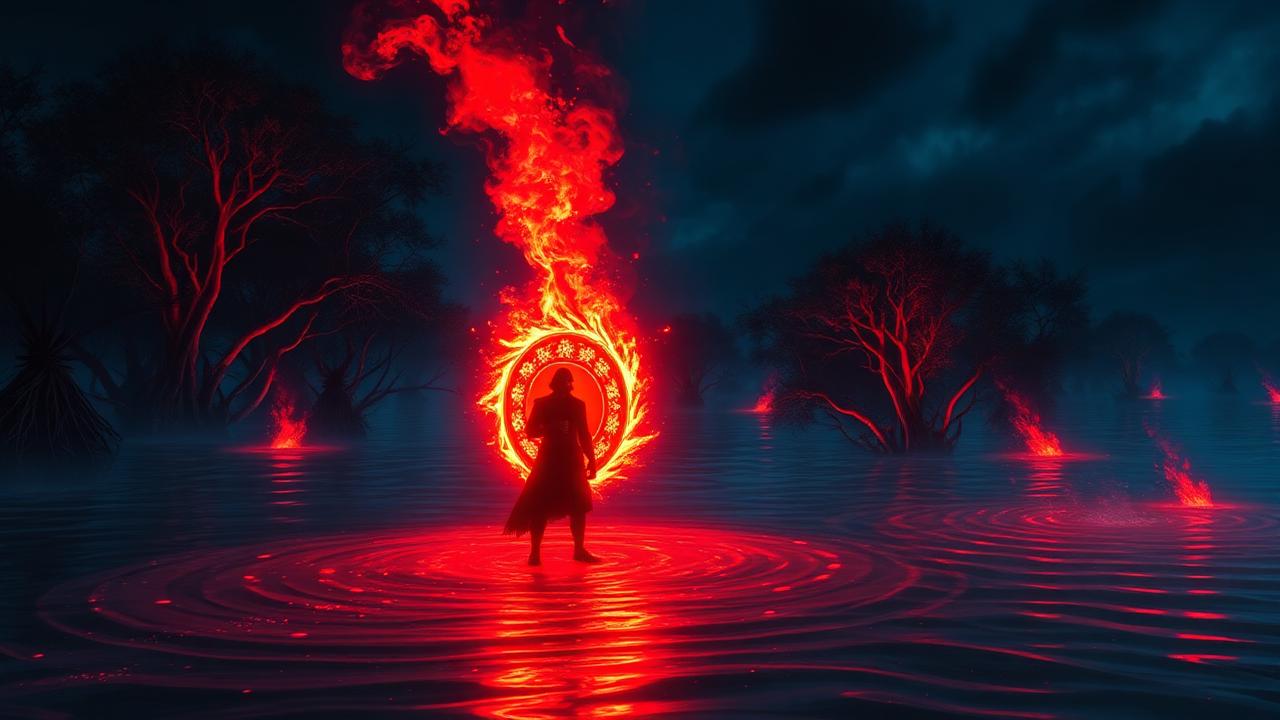
Egbesu: The Principle of Justice
Among the various metaphysical intelligences, Egbesu holds a unique position. Often misunderstood as merely a deity of warfare, Egbesu is more accurately defined as the divine principle of justice and moral order.
Egbesu is invoked when the Ijaw nation faces existential threats or ecological annihilation. The "power" of Egbesu is predicated on spiritual purity — it is a defensive force that can only be wielded by those who adhere to a strict moral code. If you carry anger for ego, the force turns against you. If your cause is just, the Red (Odua) fire protects like an impenetrable shield.
"Egbesu does not fight for the wicked. He fights for the creek, for the fish, for the children who have not yet been born."
What the corrections were checked against
Where a note on this page says a term "returns nothing", it means we could not find it in these works, in the Izon lexical sources, or in general search. Absence of evidence is not proof of invention — an oral tradition can be real and unpublished — but it does mean we cannot put it forward as documented.
Horton, R. (1962). “The Kalabari World-View: An Outline and Interpretation.” Africa 32(3), 197–220. — The four-level scheme, and the three classes of free spirit.
Horton, R. (1961). “Destiny and the Unconscious in West Africa.” Africa 31(2), 110–116. — Destiny as prenatal desire — what the spirit wanted, not what it was given.
Wariboko, N. (1999). “Counterfoil Choices in the Kalabari Life Cycle.” African Studies Quarterly 3(1), 3–21. — oju (body) and teme (spirit); duein, oru and owu; Owamekaso as head of the oru.
Tasie & Ofuru (2013), as cited in “African Names of God”, Niger Delta Journal of Gender, Peace & Conflict Studies 4(4), 2024. — Temearau and the Okrika Tamunoba as names of the Supreme Being.
Okara, G., and the recorded Woyengi–Ogboinba myth. — The created spirit chooses its own destiny, and is held to the choice.
Barley, N., and the museum literature on duein fubara (British Museum; Minneapolis Institute of Art). — so as the fate seated in the forehead; duein as the lineage dead.
Alagoa, E. J. (2005). A History of the Niger Delta. Onyoma Research Publications. — Delta political history, the canoe houses, and the Arogbo Agadagba.