
At the edge of the Atlantic Ocean, where rivers dissolve into creeks and land becomes water, a language has survived for thousands of years—spoken, sung, drummed, and remembered. That language is Ijaw (Izon).
To many, it is a "minority language" of Nigeria's Niger Delta. To history, linguistics, and cultural memory, it may be something far more profound: one of the oldest continuously living linguistic systems on Earth.
This is not a story about nostalgia or ethnic pride. It is a story about humanity's memory, and what happens when we allow it to disappear.
"What if one of humanity's oldest technologies was not stone, fire, or metal—but language itself?"
Language Is Not Just Speech
It Is Technology
Before writing, before machines, before mathematics, there was language. Early human societies did not treat language as a neutral tool. In ancient civilizations—from Kemet (Egypt) to Sumer—language was understood as a technology of reality: a system capable of storing law, science, medicine, astronomy, morality, and cosmology.

Modern linguistics now confirms what ancient societies intuitively knew:
Language preserves history far older than stone, metal, or ink.
Artifacts decay. Grammar survives.
This is why the survival of Ijaw matters to the world.
A Linguistic Anomaly
That Demands Global Attention
What Established Linguistics Tells Us
The late Professor Kay Williamson, one of Africa's most respected linguists, classified Ijaw (Ijoid) as:
- Highly divergent from other Niger-Congo languages
- Structurally isolated—lacking close linguistic relatives
- An early split from the Niger-Congo language family
Unlike Yoruba, Igbo, or Akan—languages that share relatively recent ancestors—Ijaw stands largely alone.
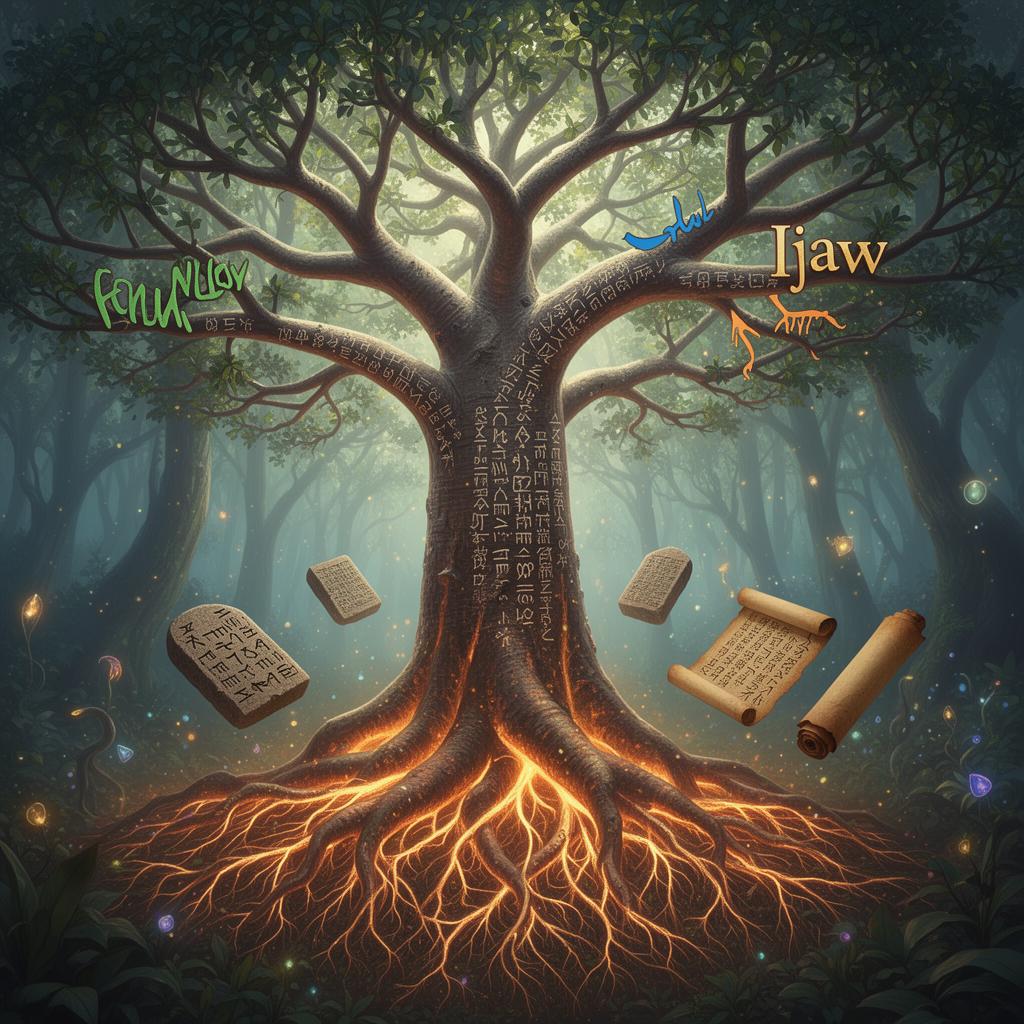
Key features include:
- An unusual Subject–Object–Verb (SOV) word order (older than SVO structures)
- Absence of noun-class systems common to Niger-Congo languages
- Heavy reliance on tonal precision to encode meaning
Williamson’s lexicostatistical work put the separation of Ijoid from Igboid, Edoid and Yoruboid at seven thousand years or more. Treat it as an order of magnitude rather than a date: it rests on glottochronology, which historical linguists no longer accept for absolute dating. Even read conservatively it places Ijaw at a depth comparable to:
- Early Egyptian
- Ancient Sumerian
A comparison of age, and only of age. Neither language is related to Ijoid, and Egyptian belongs to a different family altogether.
The difference is stark:
Sumerian is dead. Old Egyptian is dead.
Ijaw is alive.
For science, this makes Ijaw a linguistic coelacanth—a living fossil of human speech.
Interactive Timeline: 7,000 Years of Linguistic History
Proto-Niger-Congo Origins
The ancestral language family begins to diverge in West Africa
Ijoid Language Split
Ijaw (Ijoid) diverges as an early, distinct branch from Niger-Congo
Sumerian Writing Emerges
First known writing system appears—Ijaw is already an old language by then
Nile Valley Civilizations
Ancient Kemet flourishes — contemporaneous, but not connected
The Earliest Excavated Delta Settlements
The oldest radiocarbon dates yet recovered in the Niger Delta
The Kumoni-Oru Migration Narratives
Oral traditions of an ancestral identity and a journey to the creeks
Kay Williamson's Classification
Modern linguistics formally classifies Ijoid as a divergent branch
Digital Preservation Era
IjawConnect and global efforts to preserve linguistic heritage
The Oru Memory
Oral Tradition and the Nile Valley Question

What Oral History Preserves
Long before academic linguistics, Ijaw elders preserved migration narratives centered on an ancestral identity known as the Oru.
Documented extensively by Professor E.J. Alagoa, these oral traditions describe:
- An origin from the northeast of Africa
- Migration along inland waterways
- Settlement in the Niger Delta because of its ecological similarity to earlier homelands
That is what the traditions say. Whether they record a journey that happened is a separate question, and the answer this site reaches is no — set out in full on the Origins page. Ijoid is classed within Niger-Congo and Egyptian is Afroasiatic; no linguist places them together. The word pairs usually offered compare Ijaw against Greek renderings of Egyptian words rather than against Egyptian. The cultural parallels are of a kind that recurs on every continent.
Keeping the narratives is still worth doing, and this page keeps them. They are evidence of what a people remembers and how it understands itself. Alagoa's own framing is the useful one: Okorobia, writing in the Ijaw History Project's volume, notes that the Ijo “have lost all remembrance of a time before they entered the Niger Delta” — and adds, pointedly, that this “does not necessarily mean that the Ijo are autochthonous.” It means the span exceeds what oral tradition can hold.
Alagoa's method is itself the argument. His 1972 book is subtitled An Historical Interpretation of Ijo Oral Tradition: the narratives are treated as evidence to be cross-examined, corroborated and dated, rather than as legend to be waved through or waved away.
A sentence previously quoted here and attributed to Professor Alagoa has been removed. We could not trace it to any of his published work, and an invented quotation in an archive is worse than no quotation at all.
| Language | Region | Key Feature | Ijaw Parallel | Status |
|---|---|---|---|---|
Ancient Sumerian c. 3100 BCE | Mesopotamia | Earliest known written language | Contemporary oral tradition, same timeline (~5000 years) | 🔴 Extinct |
Old Egyptian c. 3000 BCE | Nile Valley | Hieroglyphic system, Afroasiatic language | Comparable antiquity only — unrelated language family | 🔴 Extinct |
Mandarin Chinese ~3000 years | East Asia | Tonal precision for meaning | Complex tonal system encodes meaning shifts | 🟢 Living |
Polynesian Languages ~3000 years | Pacific Islands | Navigation encoded in vocabulary | Water/tide terminology, maritime culture | 🟡 Endangered |
Hebrew ~3000 years | Middle East | Moral action encoded in verb structure | Egbesu philosophy—speech as causal force | 🟢 Living |
Tamil ~2500 years | South India | Ancient poetic grammar preserved | Proverbs, oral poetry traditions | 🟢 Living |
Key Insight: While Sumerian and Old Egyptian are extinct, Ijaw remains a living language— making it an irreplaceable "control group" for understanding ancient human cognition.

The parallels do not converge on a shared origin; examined one by one they dissolve. What survives the examination is the thing worth having anyway — a people among the delta’s earliest inhabitants, speaking a language so distinct that specialists argue over whether it belongs to Africa’s largest family at all. That needs no borrowed pedigree.
To lose Ijaw oral memory is to lose questions humanity has not yet finished asking.
Egbesu, Sound & The Science of Precision
Language as Causal Force
Ijaw cosmology understands language as causal.
The concept of Egbesu—often translated as justice or war—is better understood as cosmic alignment: when speech, action, and truth resonate correctly, order is enforced.
This worldview rests on the power of sound. Ijaw is a tonal language where minute pitch changes radically alter meaning. In pre-modern societies, this precision allowed:
- Long-distance communication via drums
- Compact storage of complex information
- Oral transmission of law, medicine, and history
From a modern perspective, this resembles digital encoding:
Finite sounds. Strict rules. Infinite meanings.
Language here is not poetry alone—it is engineering.
A Living Scientific Archive
Medicine, Ecology, Climate

An Ijaw fisherman knows tides by name. An Ijaw herbalist knows plants by function, not category. An Ijaw elder remembers floods that happened generations ago.
This knowledge lives inside language.
Ethnobotanical studies in the Niger Delta have documented dozens of medicinal plants whose uses are encoded in Ijaw vocabulary—knowledge absent from modern pharmacology.
As the world faces:
- Climate instability
- Biodiversity loss
- Medical resistance
Indigenous languages like Ijaw are not cultural artifacts. They are datasets humanity has not yet decoded.
When a language disappears, this knowledge vanishes permanently.
Ijoid languages diverged from Niger-Congo around 3000 BCE
Across Niger Delta and global diaspora
Including Izon, Okrika, Kalabari, Nembe, Ibani
Ijaw communities span Bayelsa, Rivers, Delta, and more
The Urgency of Preservation
Current status of Ijaw language vitality
"When an elder dies, a library closes."
In Bayelsa State alone, an estimated 2,000+ unique vocabulary items are known only to speakers over 70 years old.
Global Scientific Significance
Ijaw is not just a cultural artifact—it is a dataset humanity has not yet fully decoded
Cognitive Diversity
Unique Subject-Object-Verb structure offers insights into early human thought patterns
Tonal Precision
Complex tone system resembles digital encoding—efficient information storage
Ecological Knowledge
5,000+ years of delta ecosystem vocabulary—invaluable for climate science
Historical Archive
Oral traditions preserve pre-colonial African history unavailable elsewhere
The Out-of-Africa Lens
Why This Is Everyone's Story

Genetics confirms that all modern humans trace their origins to Africa.
But Africa is not monolithic. Africa contains the deepest human diversity on Earth.
Communities with long regional continuity—like the Ijaw—preserve cultural patterns that may resemble early human societies before empire, writing, and mass migration.
Studying Ijaw language and worldview offers a rare opportunity:
To understand how humans organized reality before civilization hardened into institutions.
This is not about claiming primacy. It is about remembering complexity.
A Human Story
Why This Moment Matters
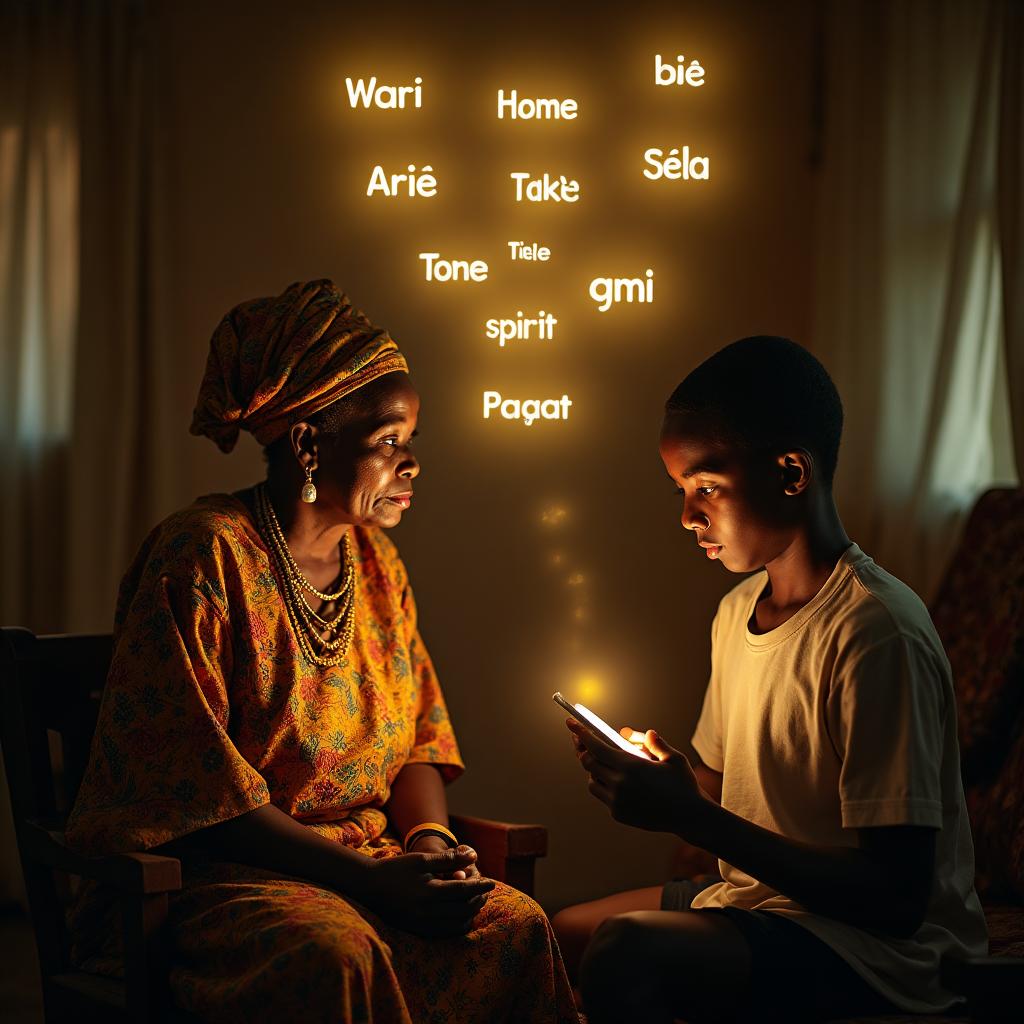
In Bayelsa State, a grandmother speaks fluent Ijaw. Her grandson understands English—but not her words.
"When she dies, a library closes."
This is happening quietly, daily, across the Delta.
Language loss is not dramatic. It is silent.
The Researchers Behind the Research
The scholars whose work forms the academic foundation for understanding Ijaw linguistic heritage
E. J. Alagoa
Historian of the Niger Delta
Established that Ijo oral tradition could be read as historical evidence, and built a history of the Delta out of it
That oral tradition is evidence — to be cross-examined and dated like any other source, rather than taken at face value or dismissed as legend. His 1972 history is the method applied at book length.
Kay Williamson (1935–2005)
Linguist of the Delta languages
Described Ịjọ from the inside and placed Ijoid within Niger-Congo, then spent thirty years documenting the Delta's smaller languages
That the Delta's languages deserve description in their own right, not as dialects of larger neighbours — and that description is worthless unless it reaches the people who speak them, which is why she put as much work into school primers as into grammars.
Roger Blench
Linguist and Africanist
Finished and published the work Williamson left unfinished, and mapped Nigeria's languages as a whole
That the Delta's smaller languages are vanishing faster than anyone is recording them, and that the greater scandal is the material already recorded and left unpublished in dead scholars' drawers.
The Verdict
A Global Responsibility
Preserving Ijaw means preserving:
- 🗝️ A Rosetta Stone of African prehistory
- 🧠 A unique cognitive system
- 🌊 A climate-adapted civilization
- 🔊 A sonic technology of meaning
To let it disappear is not neutral. It is a decision to forget.
What IjawConnect Stands For
IjawConnect exists to digitally preserve the language, build open linguistic archives, support research and education, and connect Ijaw knowledge to global science, culture, and technology.
To the world, we say:
The Ijaw language is not local.
It is ancestral.
It belongs to humanity.
Share this article